
Cut Vs Thrust Sideswords
with a few measurements

In the last post, where I was looking at a pommel motif, I called the first piece showcased a “Gorgeous Unknown”. I had no information about it, in spite of how much I liked the look of it. Since then, not only have I identified the piece and found more pictures of it, but I have also found an extensive set of measurements.
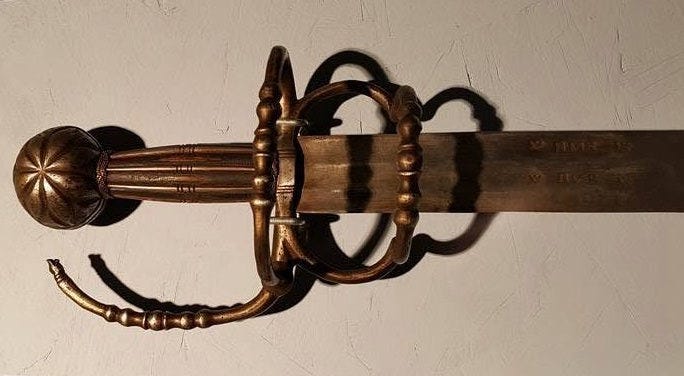
In a 2018 article, Florian Fortner, Julian Schrattenecker, and Karl Rapp offered a “Detailed Measurement of Edged Weapons from the Gotti Collection”, a private collection held in the Martial Arts Museum in Botticino, Italy. Not only is this piece analysed as part of that collection, but so is a different sidesword that I like a lot.
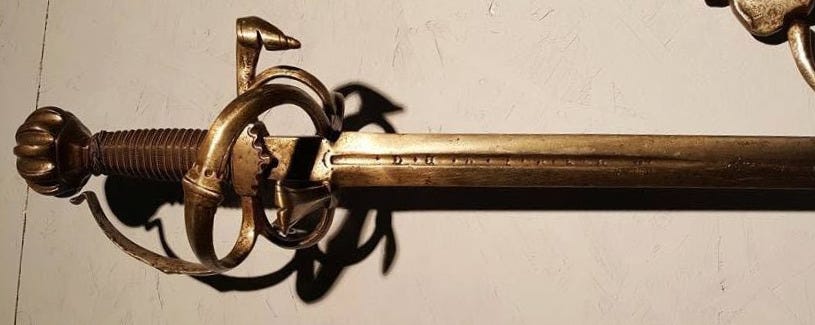
I think this is a good opportunity to showcase the two sideswords and talk a bit about cut vs thrust optimisations when it comes to sideswords.
Cut-Focused Sidesword, c.1500-1540
TL: 110.6cm, BL: 98cm, BW: 3.4cm, BT: 0.5cm, GL: 8cm, PoB: 14.3cm, W: 1170g
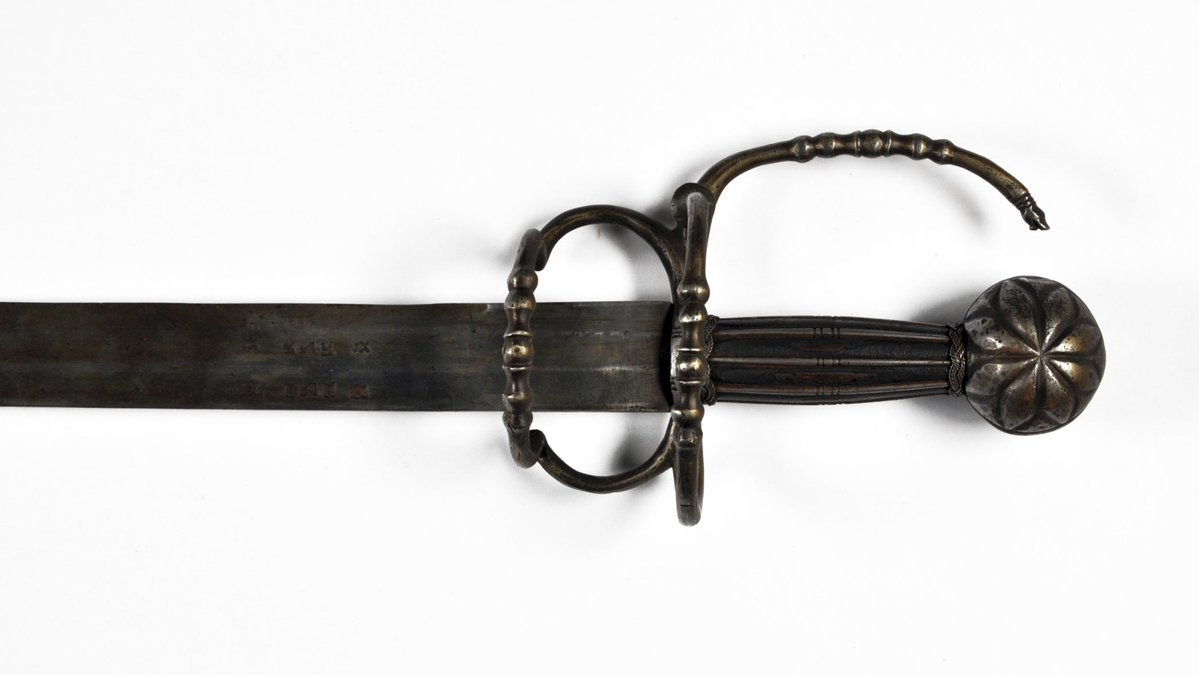
We see that the asymmetrical hilt is made up of round cross-section bars. The wooden grip tapers toward the pommel and is inlaid with iron bars and topped with turks-head knots. The spherical pommel has this flower motif that works so well for sideswords.
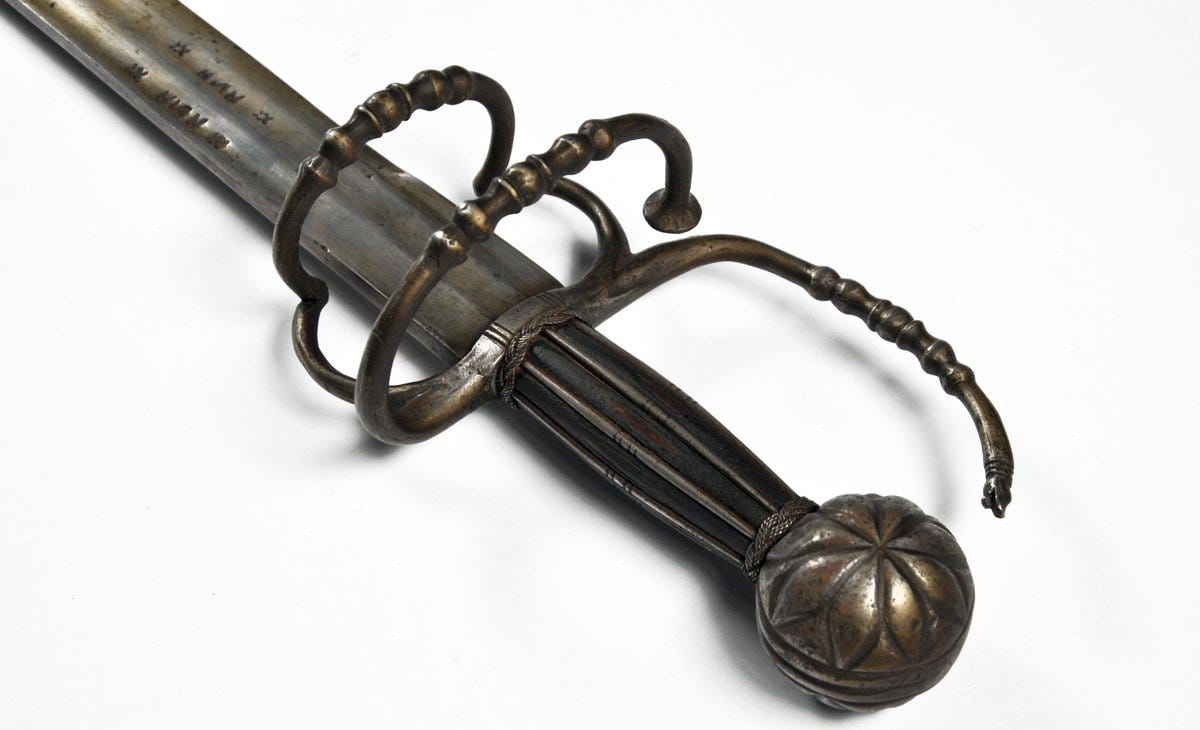
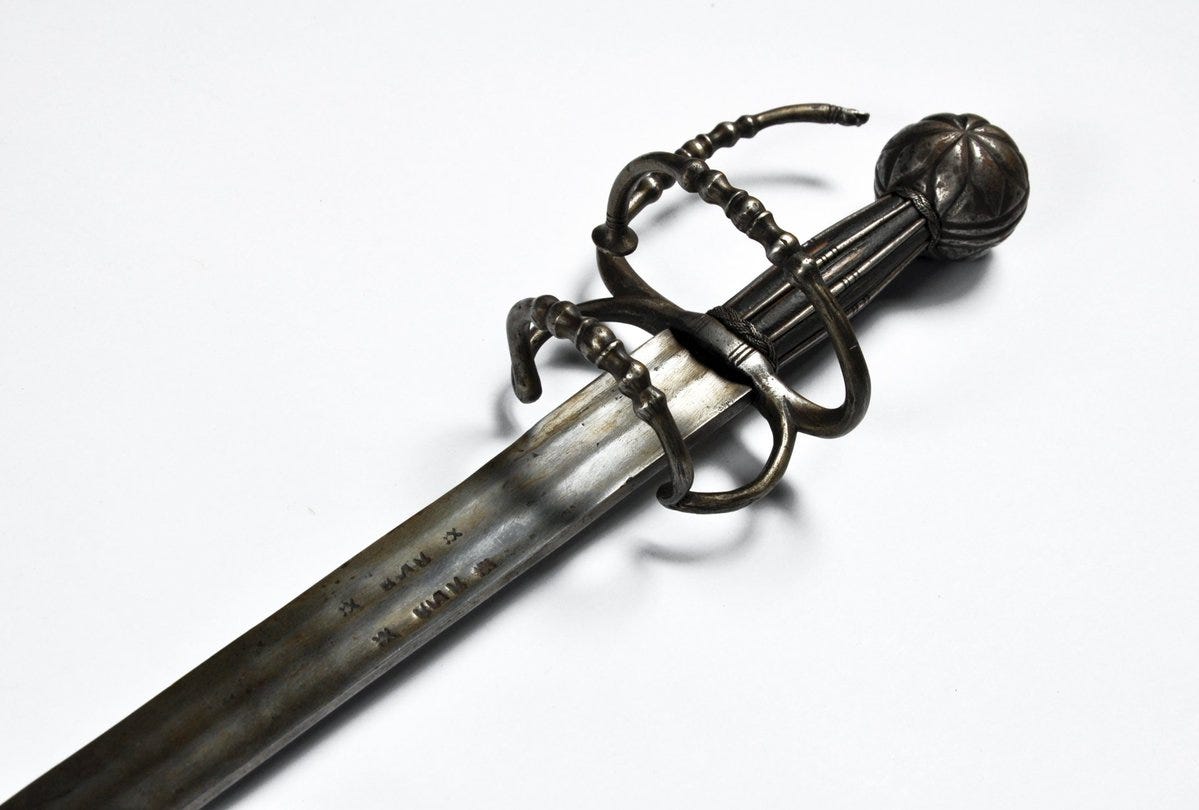
The blade is gorgeous, with a complex shape: rectangle until 6.5cm (i.e. fuller), triangle until 79cm (i.e. single edge, so a reinforced spine like a backsword), and the rest is lenticular (i.e. double edge). From the article, we find that the blade is under 2mm thick in the last 8cm, and under 3cm for 15cm or so before that. Towards the tip, it’s still 2.2cm wide. This is foremost a cutting blade, with cuts that can be delivered with the tip of this long backsword-like blade.
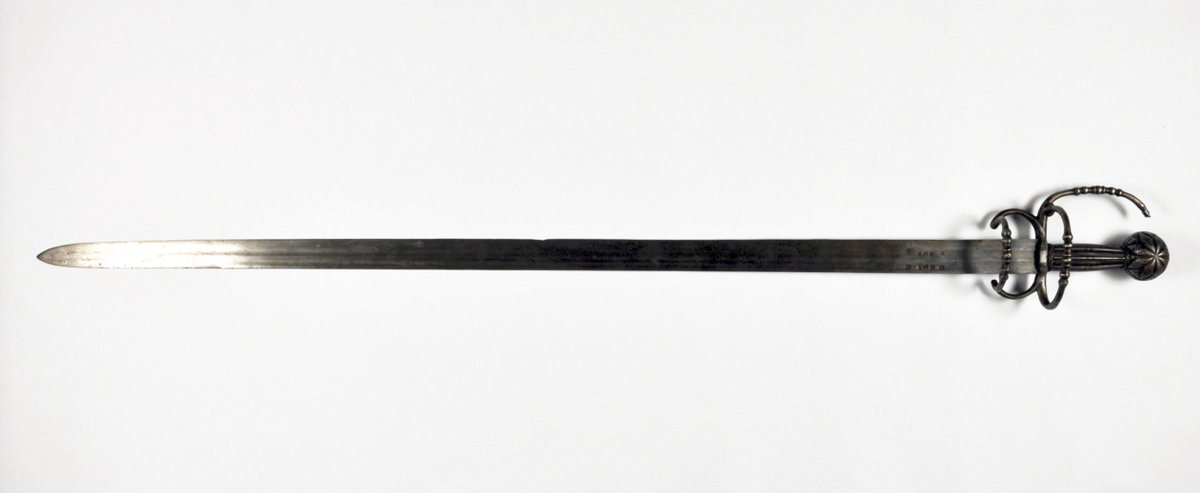
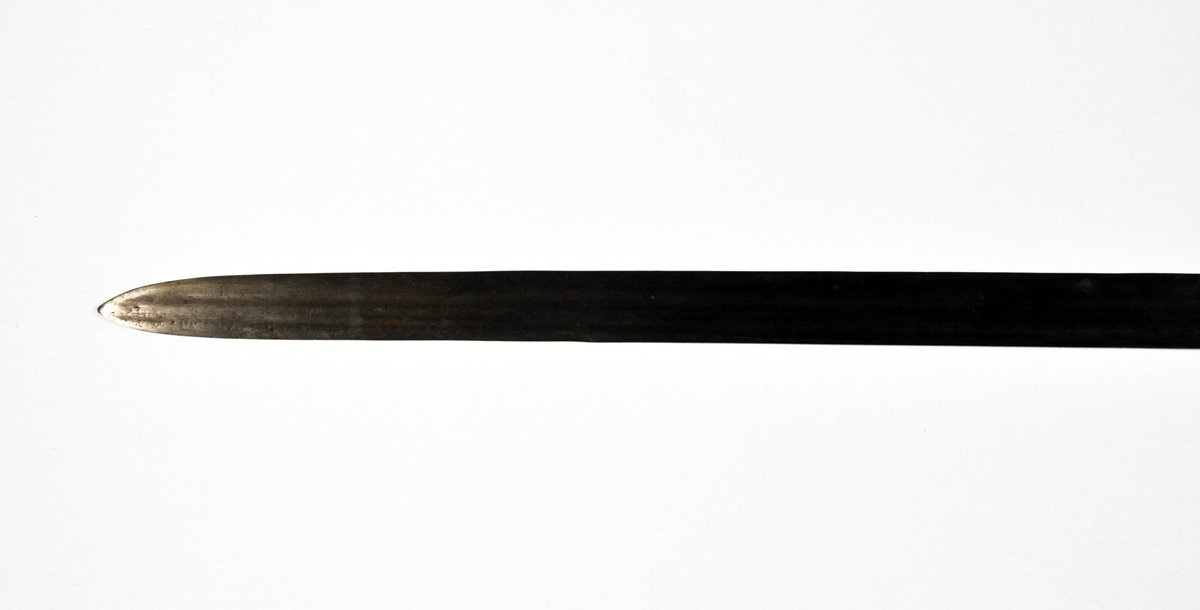
This is a cut-optimised blade, in spite of it not being that wide. The blade is long and has a forward point of balance, which should help deliver good hewing cuts. The compact nature of the hilt offers good hand protection, while not inconveniencing the use of a buckler, which would be my preferred way to use this type of sidesword.
Thrust-Focused Sidesword, c.1530-1550
TL: 105cm, BL: 92cm, BW: 2.6cm, BT: 0.78cm, GL: 7.75cm, PoB: 12.2cm, W: 1045g
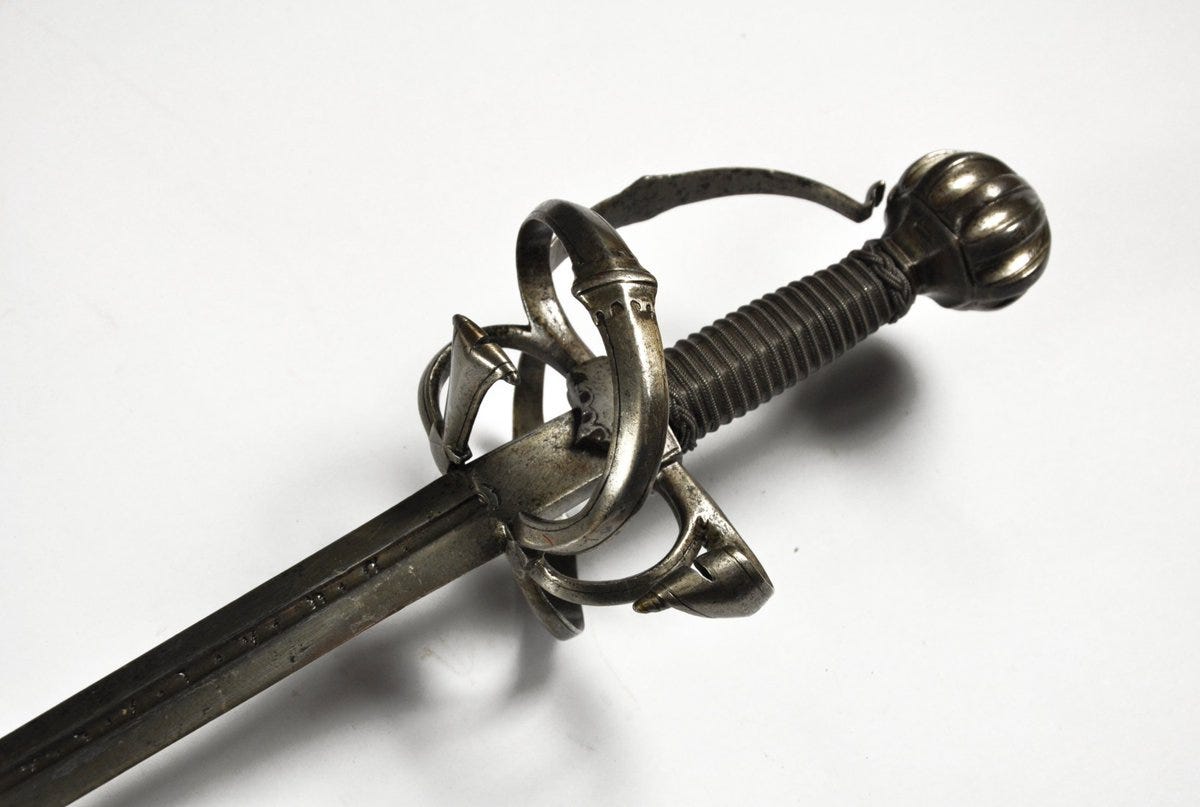
From the same source, I have also found details on this sidesword, a piece that I knew for a while and I wanted to find out more about. It can be dated to the middle of the 16th century. Based on the existence of these photos, it was sold at auction at some point (probably Czernys's).
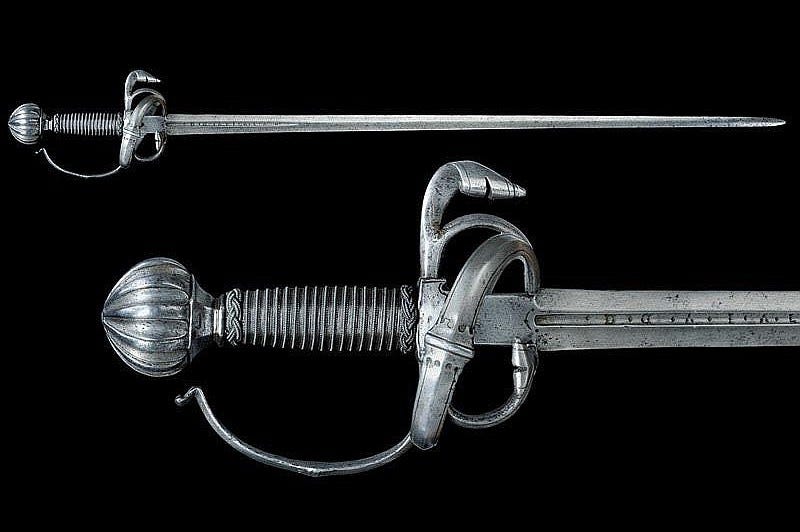
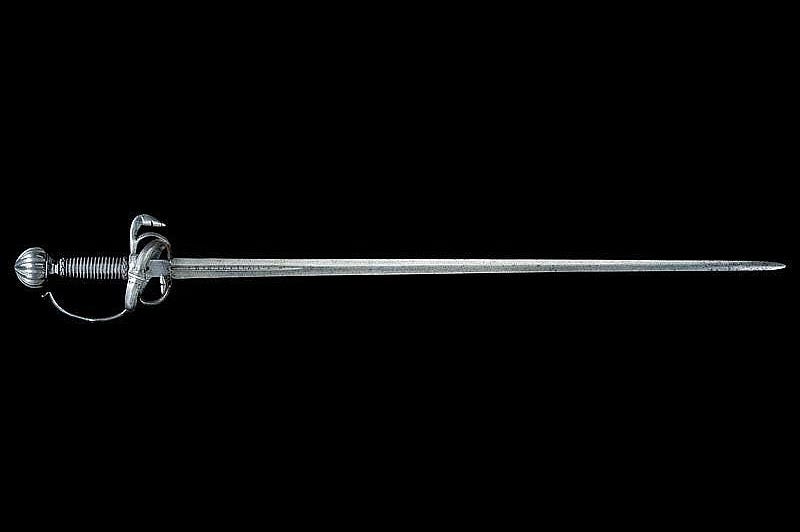
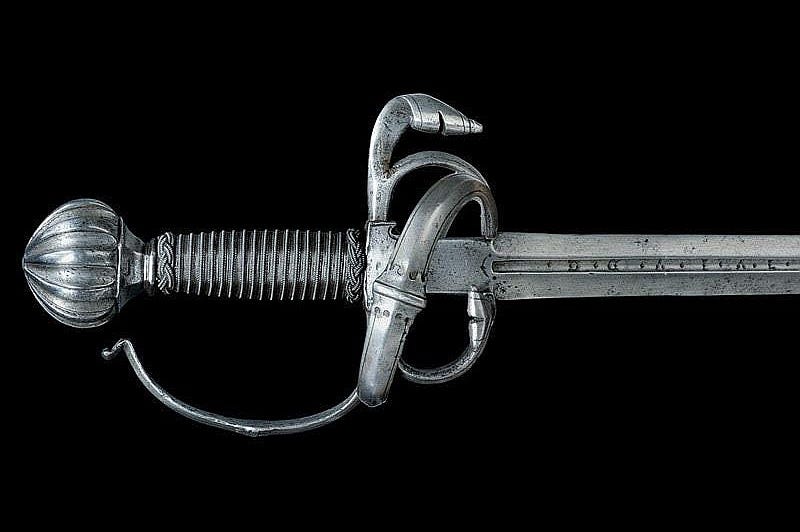
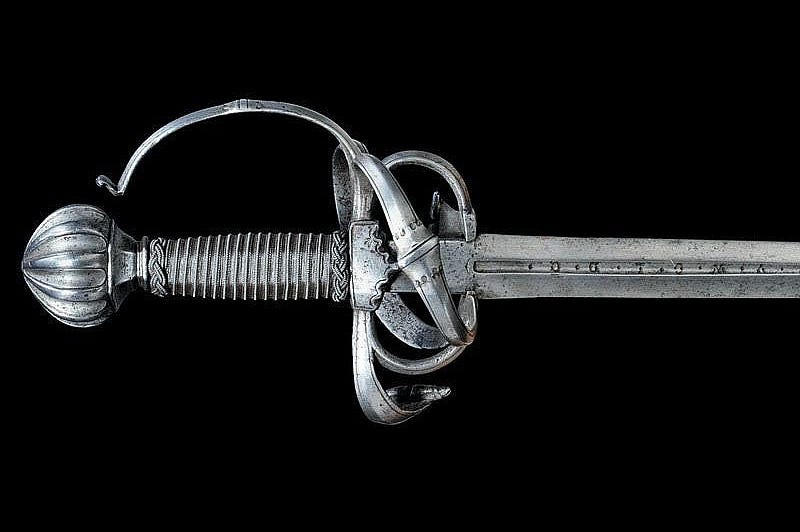
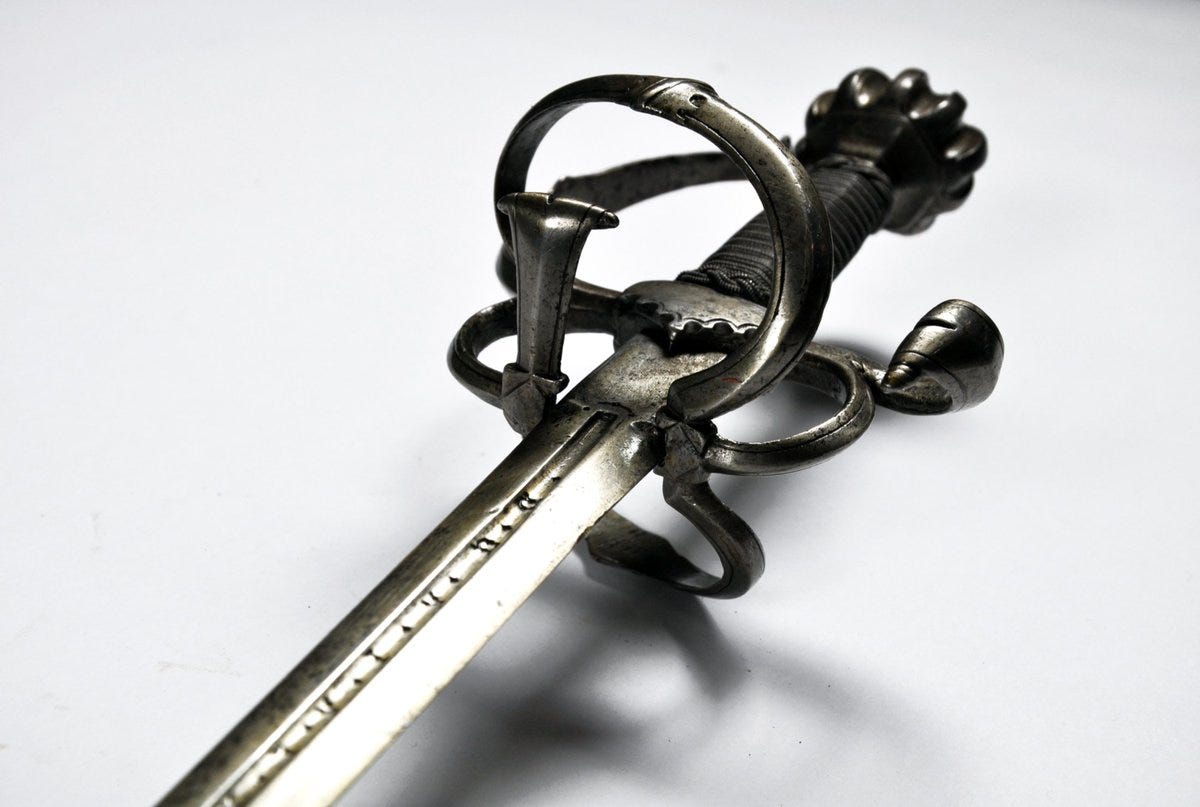
The swept hilt is made up of elegantly curved bars with scroll decoration, a wire-bound grip of hexagonal cross-section with turks-head knots at the ends and a fluted bun-shaped pommel. The inside sweep mimics the outside one, instead of the thinner round bars usually employed on such complex hilts. This is a bit surprising for me. I don’t know which style I prefer more. While stylistically similar, the inner sweep is smaller, as it needs to cover less of the hand.
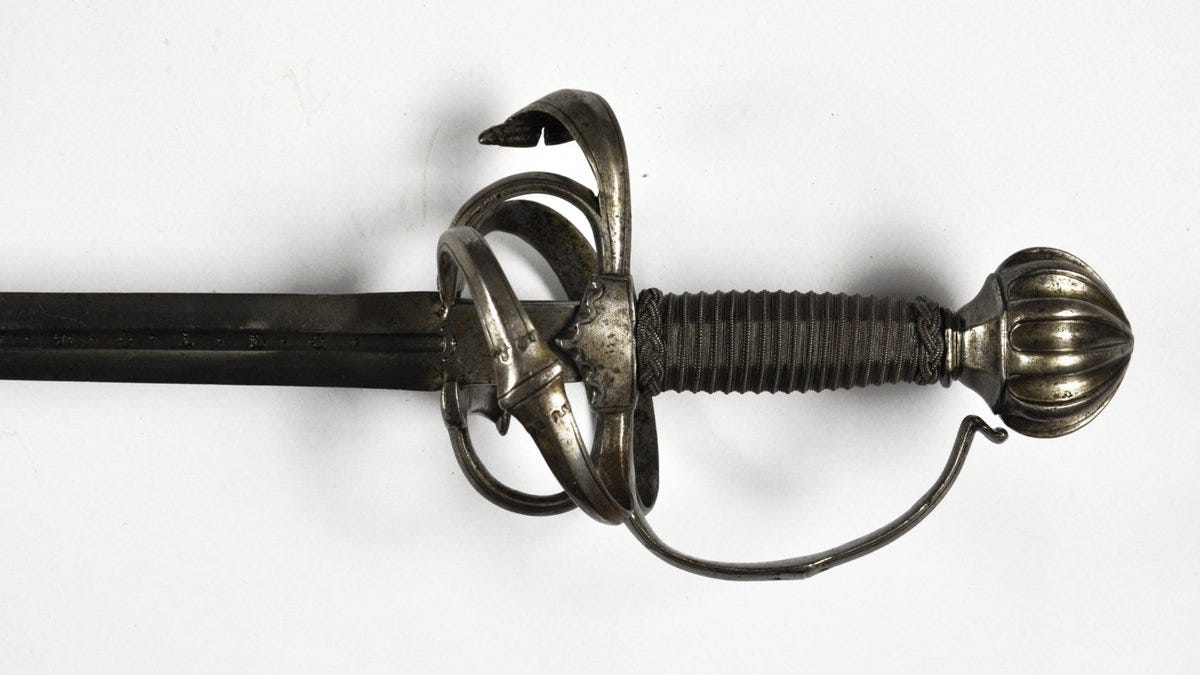
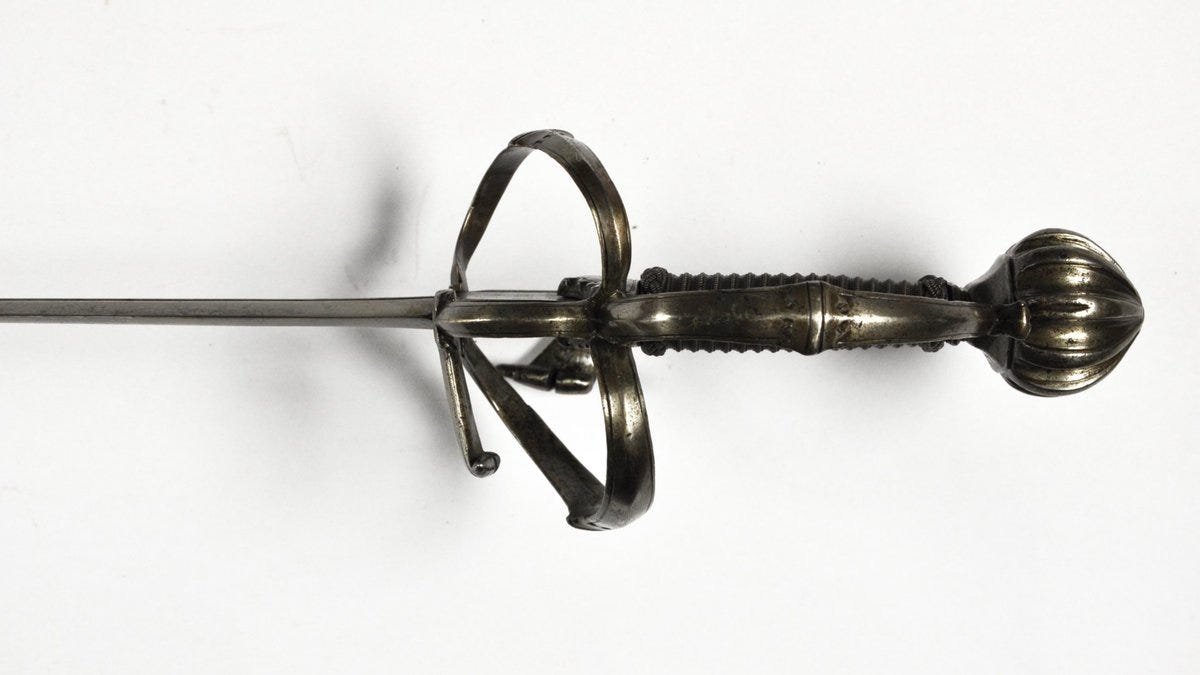
The long and slender blade is foremost designed for the thrust, and it transitions from a hexagonal to a lenticular cross-section along its length. At the very tip (some 2cm from the end), the blade is 2.8mm thick. Before the last 50cm towards the tip, this blade is thicker than at any point on the previous blade we looked at. A perfect example of the difference between a cut and a thrust-focused sidesword.
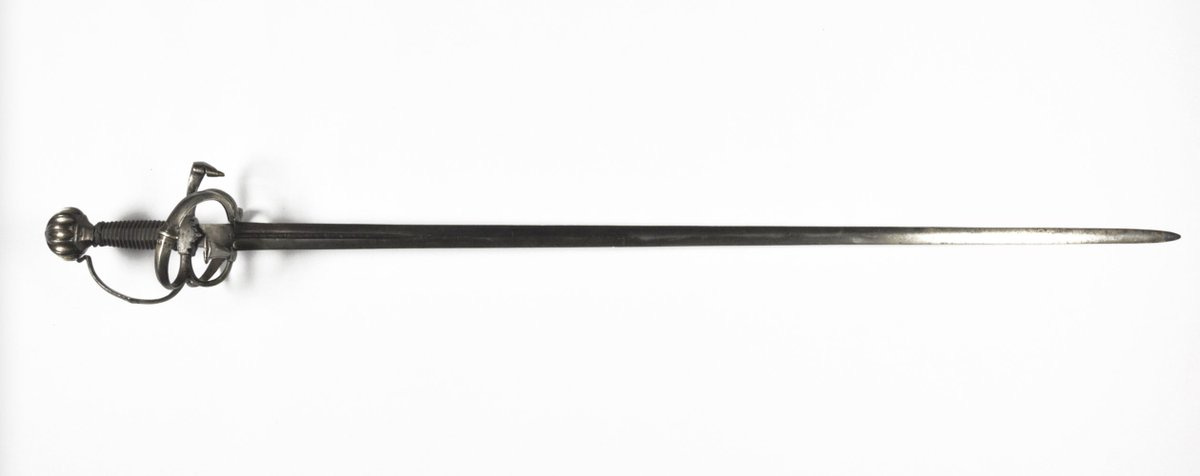
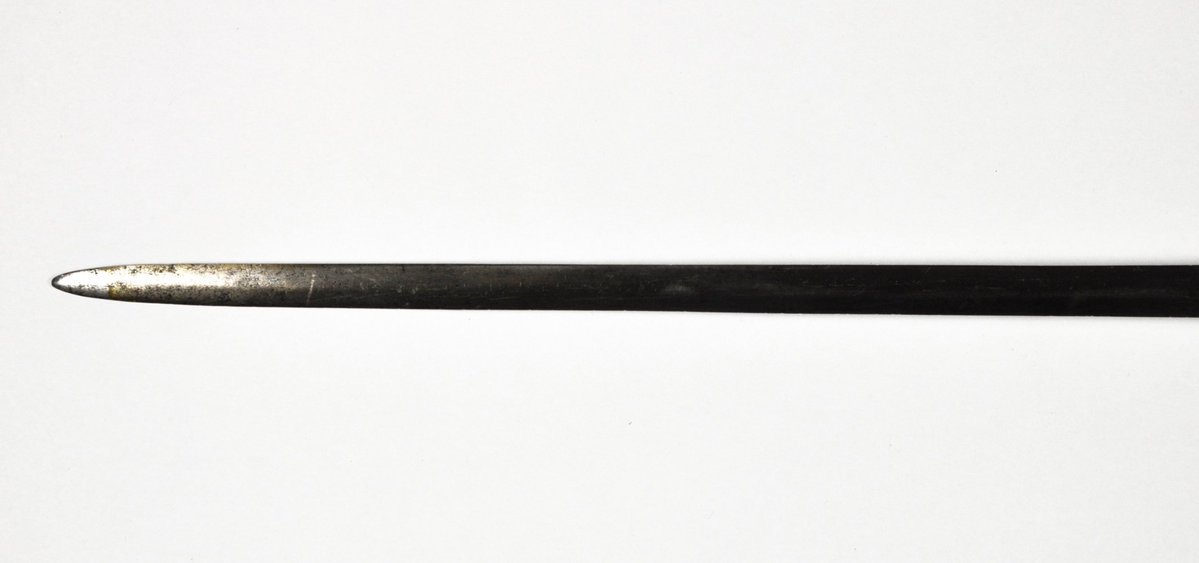
This is the development of thrust-centric sideswords, the streak-sidesword, as we see them before the emergence of the proper rapier. The thicker blade allows for better parry and riposte actions. This is better suited for sword alone techniques than a cut-focused blade would be. I would use this piece in this role as well. For this piece, considering its low weight and low PoB, I would increase the length of the blade by some 5cm, well, as much as 50g would get me. But this is a personal preference, nothing more. These days, I have found that a 12cm PoB is preferred on a lot of thrust-centric pieces, compared to the 14cm as I was expecting. The variation is also large.
Discussion
Check the article in question for more measurements for these two pieces and more. I like the cross-sectional area estimate from measurements. Since we know the density of steel, we can compute the mass distribution along the length of the blade. This matters in computing moments of inertia (proportional to the mass and the square of the radius of rotation). I am not going to delve into that, since it’s not intuitive.
In the end, for a thrust-focused sword, you want the distribution of the weight to keep the tip of the blade pointing at the opponent as you move the hand through a 2-3-4th arc (from Coda Lunga Stretta to Porta di Ferro Stretta), and not to translate along with the hilt. For a cut-focused sword, you want the blade to feel forward balanced, so that you can feel the inertia of the blade carrying over a cut. Doing a wrist cut, after the initial rotation, you should feel this inertia powering the cut halfway through the arc. The power of the cut should not be from the wrist; its role is just to initiate the cut.
Neither of these swords should feel sluggish or unresponsive when performing half-cuts. However, we see that using a buckler changes the problem a bit. I can use the buckler to parry and use a tip-cuts to punish the opponent from a distance. I can afford a much larger PoB value than otherwise, even on weightier swords. With a thrust-focused sidesword, used in a sword alone fashion, I would like it to be a bit nimbler, since I depend on being able to parry quickly, and deliver a thrust or a quick cut. At the same time, I don’t want the blade to feel so weak that I would not trust it in the parry, or when trying to control the opponent’s sword.
While both are sideswords, and both are basically from the same period, and both can probably work in the two roles mentioned here, we clearly see that one is optimised for the cut, while the other is optimised for the thrust. I think historically, people would have chosen a sidesword that would have worked best for their preferred style. Sword and buckler, or sword alone, maybe with the eventual cape or a dagger.