
Rapier Trainer
a discussion around a custom piece by Black Fencer

Black Fencer is a Spanish maker of trainer swords and other HEMA gear. Notably, they have made a name for themselves by offering synthetic swords and very affordable steel trainers. Recently, they have also started to offer sharp swords for cutting competitions and are expanding their product line. I’ll talk about the products I got from them, with emphasis on the rapier and dagger set I got recently.

Note that with the rapier, I have also got a black bag, so I don’t have to expose the blades to the autumn rain (notice the spot of rust on the sidesword that resulted from: “it’s fine, I’ll clean it in the morning”; I have cleaned it properly after taking the photo).
The sidesword experience
About a year ago, I bought a Sidesword - Steel Generation from them. I wanted something with a broad blade, and I was prepared to suffer the extra weight.
I saw a video in which Jordan Mock from Academy of Steel spared with Jay Maxwell who was using this sidesword (video below time-stamp to the fight; Jay is in the second match). I took that as an implicit endorsement or sort in respect to the dynamics. Since I liked the look of the sidesword, and the low price made this quite affordable, I decided to take the risk with a maker I knew little of at that point.
Once I received the sidesword, I started comparing it with my Malleus Martialis’s Marozzo, on which I mounted an oval pommel I got from them separately. While a few grams heavier (about 20g), the Black Fencer’s steel sidesword has an excellent balance, and it feels a bit lighter even though the point of balance is 1cm larger. I don’t really understand what’s going on, and I suspect all this is due to the moments of inertia during rotations.
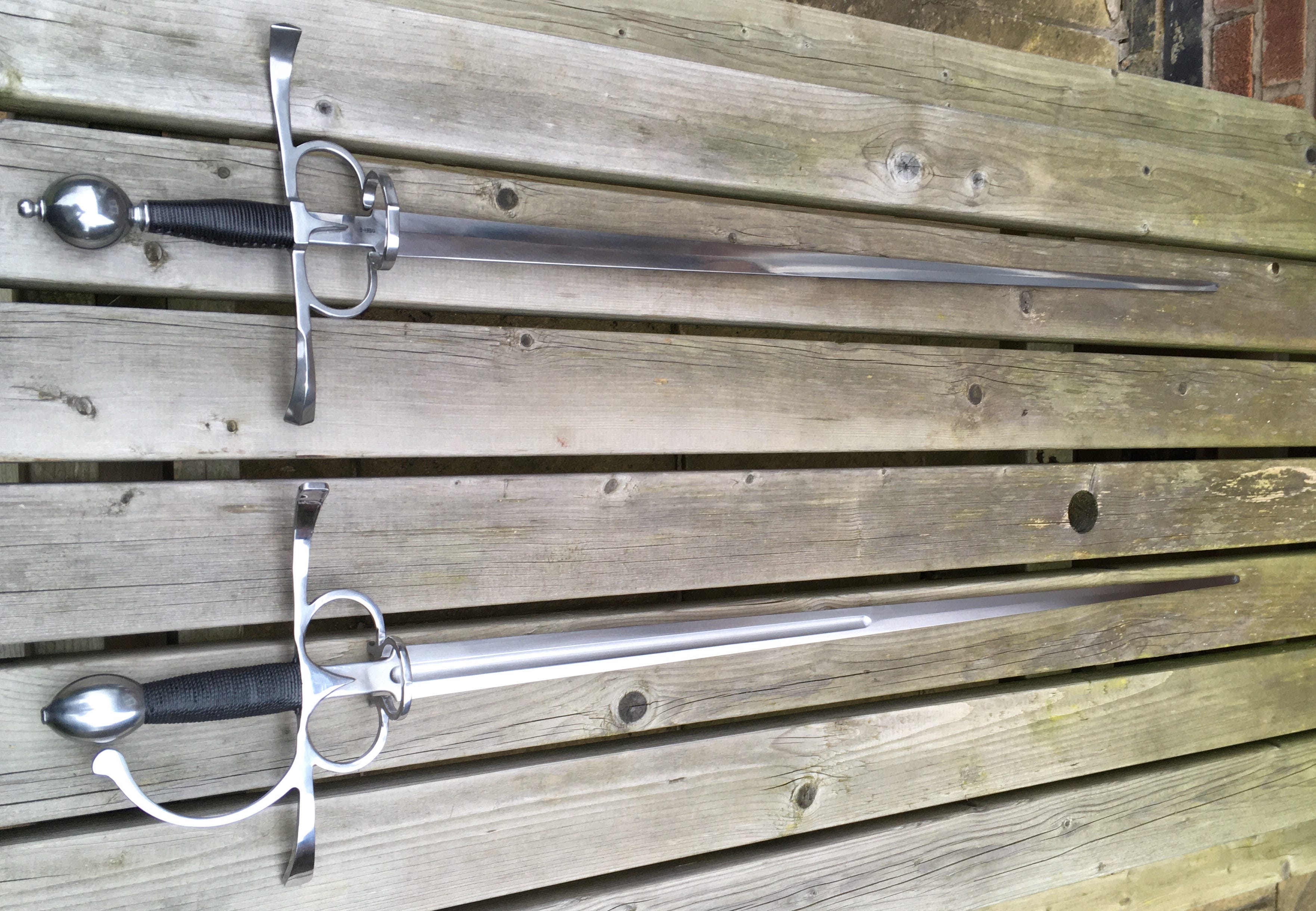
To clarify, I love my Malleus Martialis’s Marozzo, but the Sidesword - Steel Generation from Black Fencer surprised me in a good way. As a happy customer, considering how inexpensive it is (under €250), I am recommending this piece. I think it’s worth placing it next to other excellent entry-level pieces such as Kvetun’s Sidesword 1 and others. As a side note, with Regenyei Armory updating their sidesword line recently, it’s a good time to be a new person in HEMA interested in the Bolognese tradition. I am comfortable to say that entry-level sideswords are plentiful.
The only heads-up is related to the finish. That’s where the cost savings are visible. One will find residue on the blade from the rubber substance that covers the cord grip, and some black marks that remain on the steel. All this means that you will need to clean a bit the sword when it comes out of the box. Another cost-saving aspect that people should be aware of relates to the welds. They are rough-looking! They are smooth and very ergonomic, nothing will poke your hand, but they look rough. You are not getting a Balefire Blades, a Danelli Armouries, or a Florian Fortner sword here. But you are getting an incredibly well-done piece at a fraction of the cost. At this point, I think it’s the least expensive of all the good entry-level sideswords. Get one now before inflation ruins it. To sweeten the deal, Black Fencer hammers the hot blade under the crossguard (just like Albion Swords does with their trainers), making sure that it will never rattle in its lifetime.


The Rapier and Dagger
Black Fencer is also selling a Rapier and a Dagger, and they have a reputation for taking on customisations projects. I was so pleased with the Sidesword - Steel Generation that I approached them for a rapier and dagger set, that incorporated some customisations.
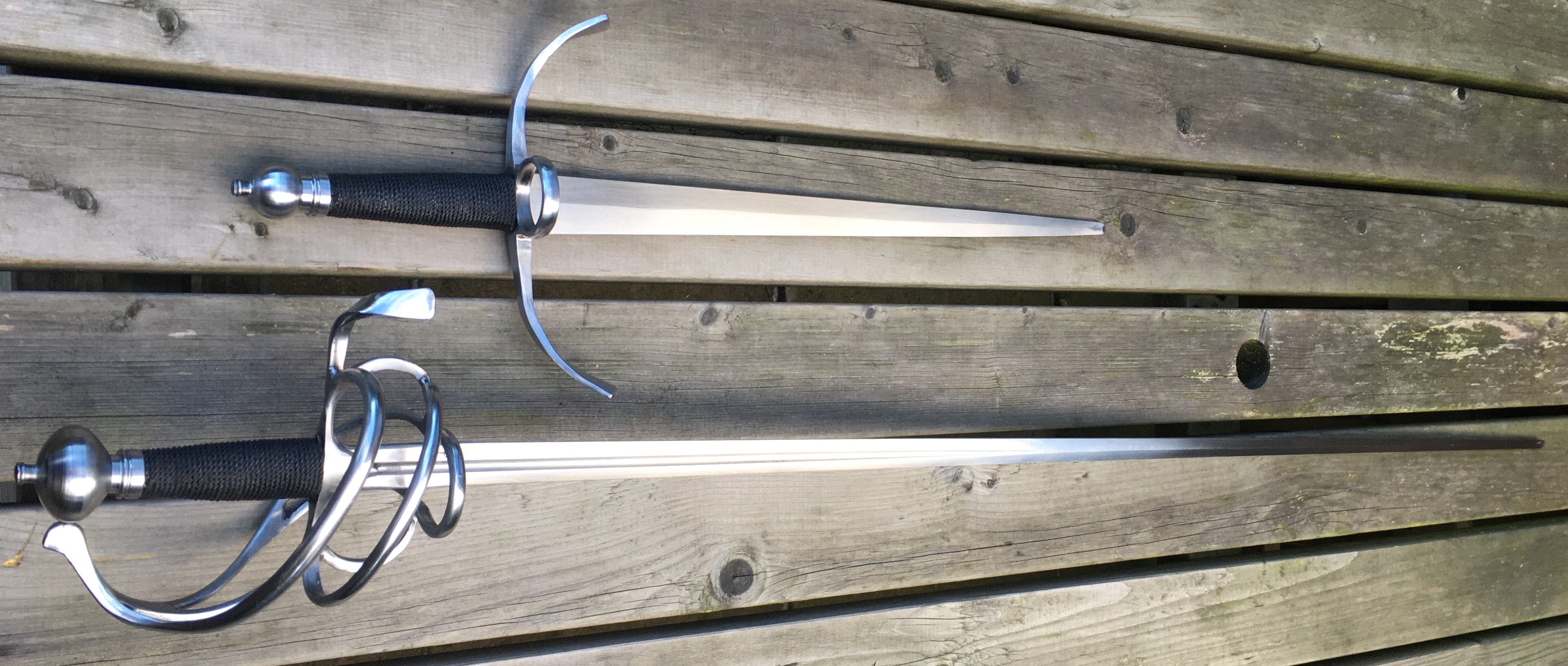
The main requirement, I wanted a Capoferro rapier, something with a 114cm (45inch) long blade. I have asked for the blade to be stiff since I was afraid that a long blade might sag under its own weight. I stated the target for the total weight to be 1200g, and I wanted a point of balance of 12cm in front of the quillon block. For the rapier’s hilt, I have asked for a screw-like swept hilt design, a look that I like quite a lot. Plus, I have asked for a small modification for the quillons of the dagger, one which they had performed in the past.
After a few email exchanges, we agreed on a design and a price (very close to the regular offer; much, much less than I expected for custom work; I am not going to divulge it since it feels like I would violate the personal arrangement I made with them, but I encourage you to contact them if you want customisations done). Since I was so happy with the feel of the sidesword, I have told them to take charge of any modifications needed to make sure that I get what I want and not what I ask for.


Dagger
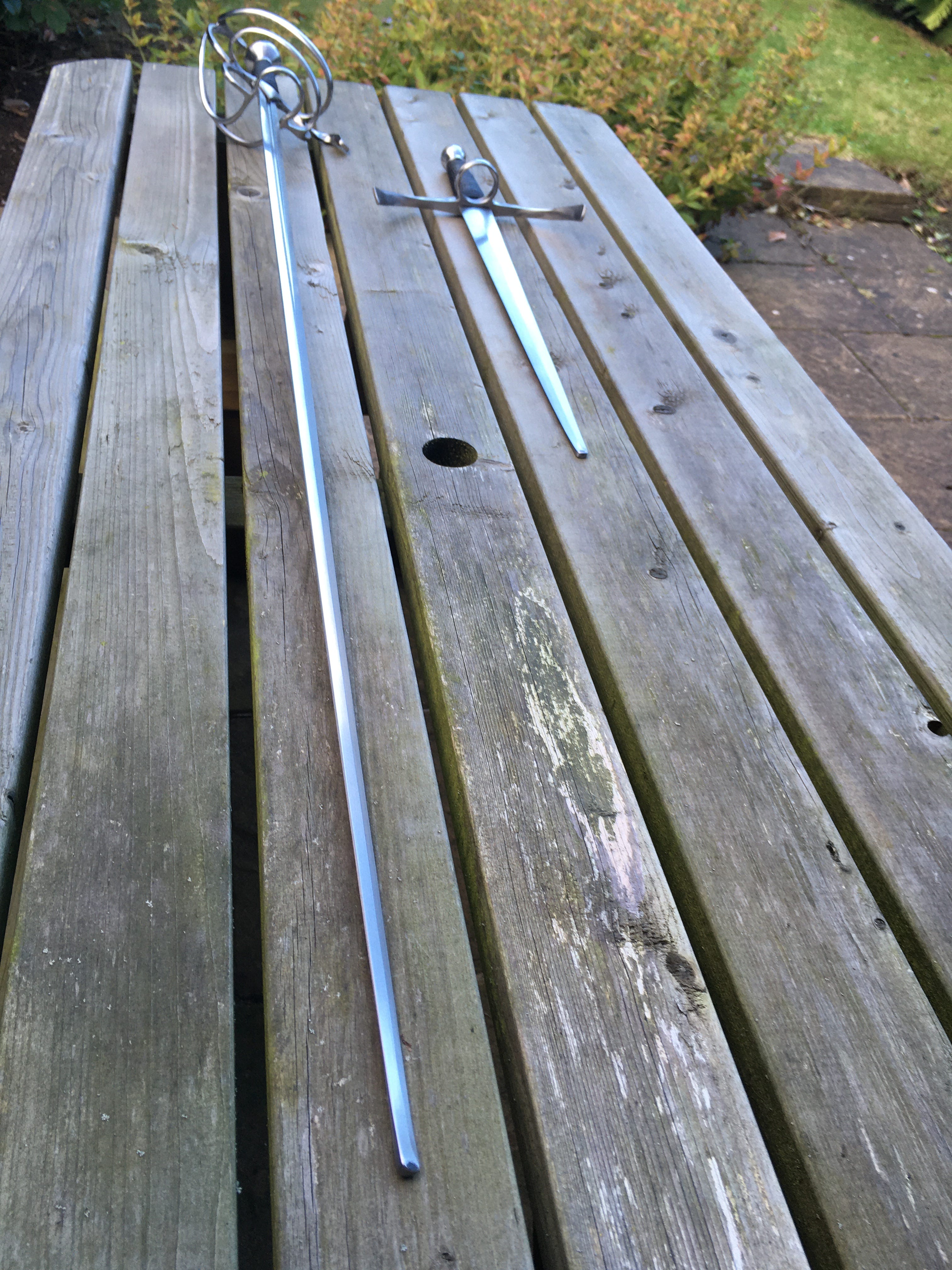
Compared to the standard Dagger, I have asked for the quillons to be swept upwards, towards the ring. Originally, I wanted the Nobilis pommel they offer on the rapier and dagger set, but Black Fencer took the initiative and offered a more appropriate set of pommels that elevate the two pieces.
The dagger feels good, and it’s comfortable to place the thumb on the blade. The blade is stiff though, very stiff, so restraint must be used in the thrust. I don’t find this to be a problem, since I use it to tap the opponent if I ever get to that point, while the stiff blade offers a tremendous level of control of the opponent’s blade, which is more important for a parrying dagger.
Weight: 621g
Total length: 61cm
Blade length: 45.5cm
Blade width: 3.5cm
Hilt length: 14.5cm
Cord grip length: 10cm
Quillons end to end width: 21.5cm
Balance point: 3cm


Rapier
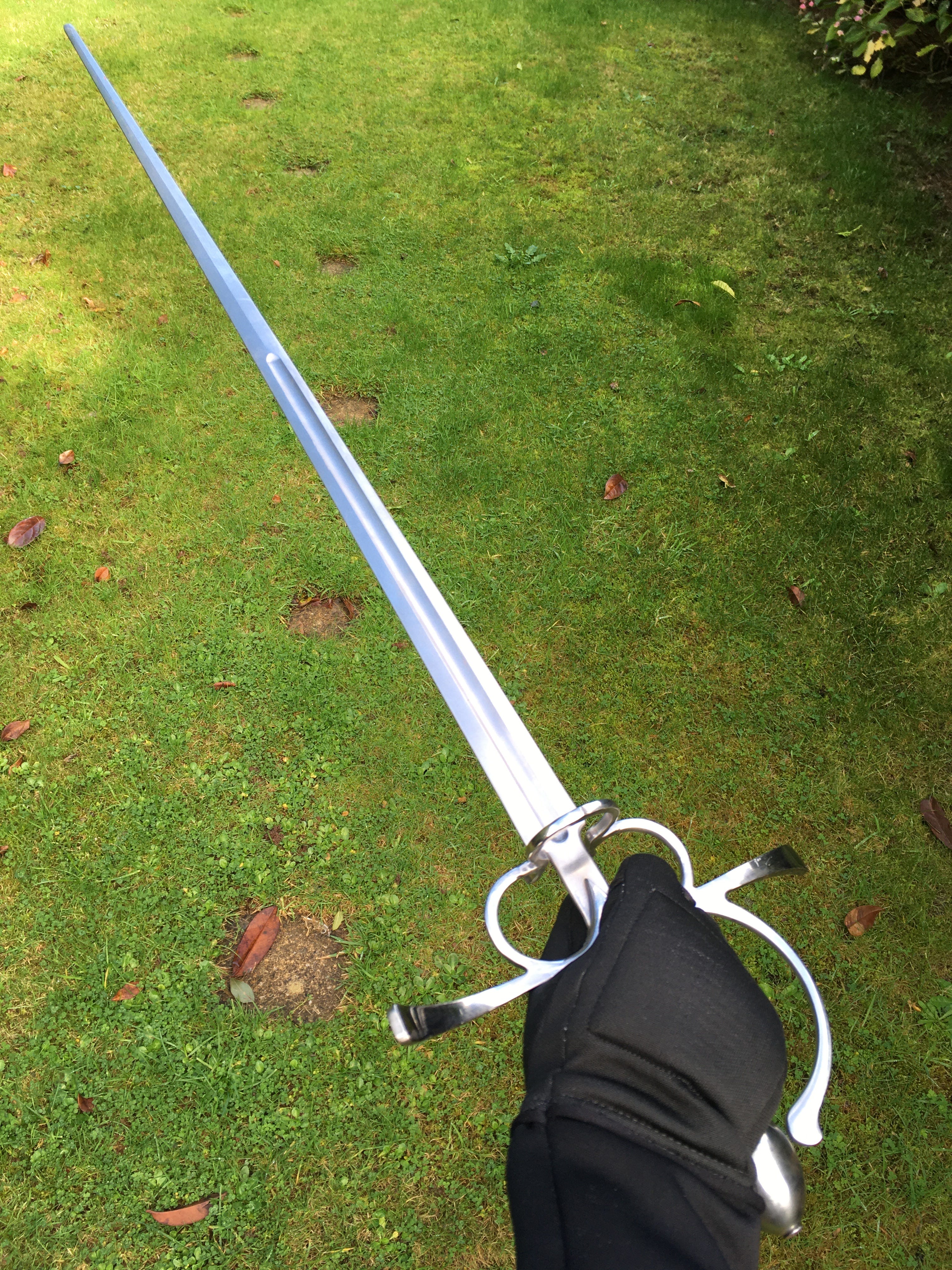
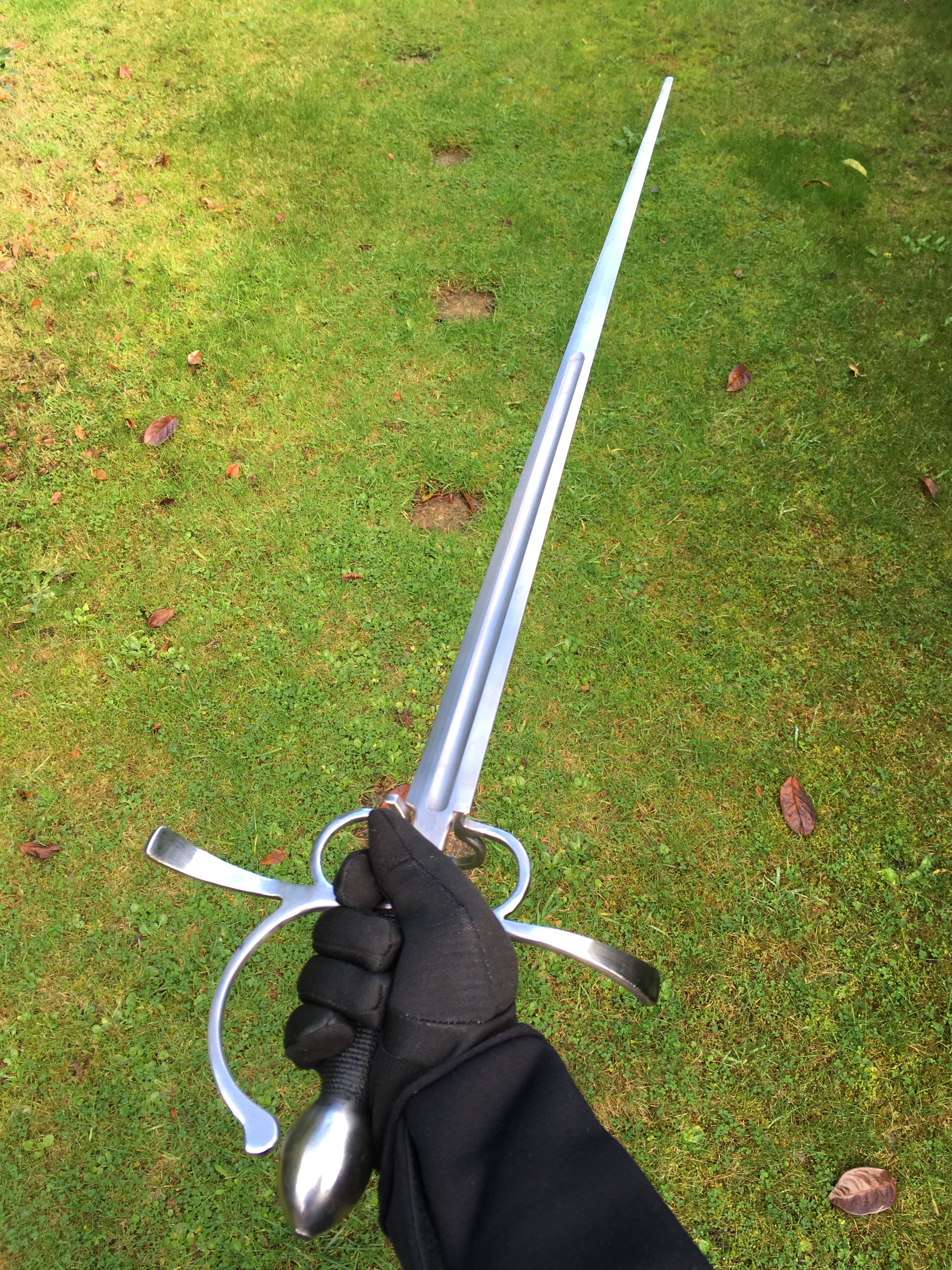
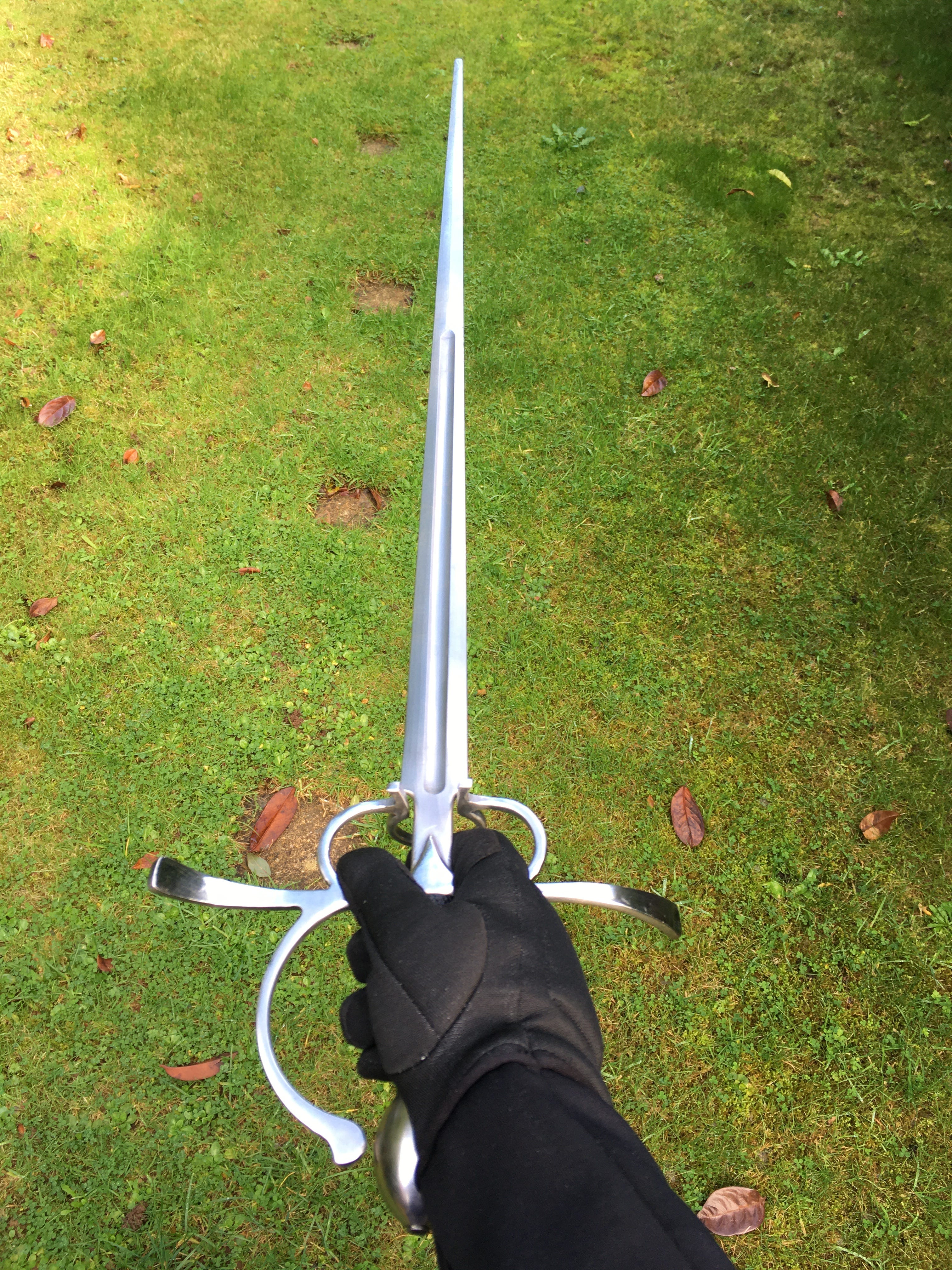
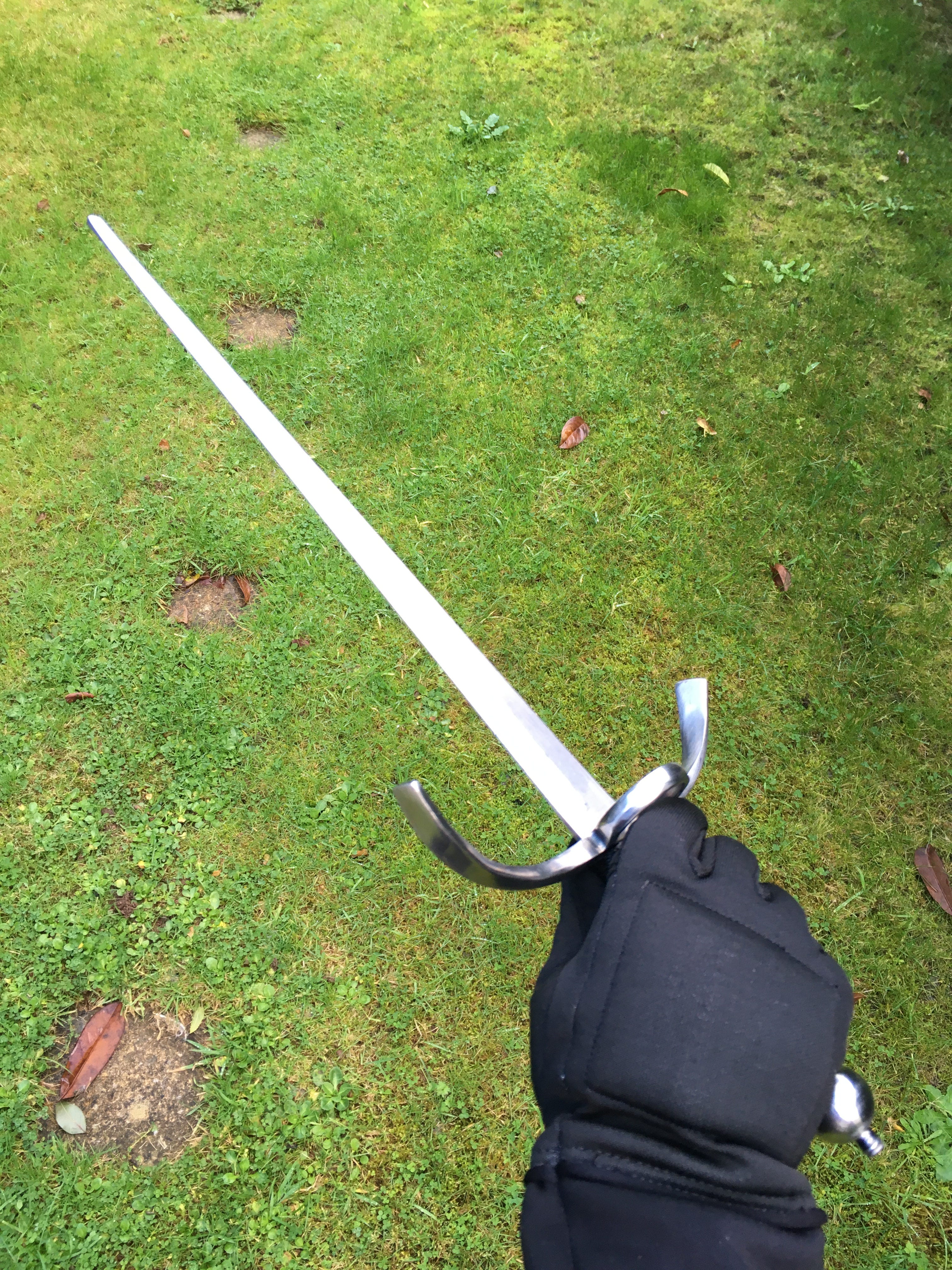
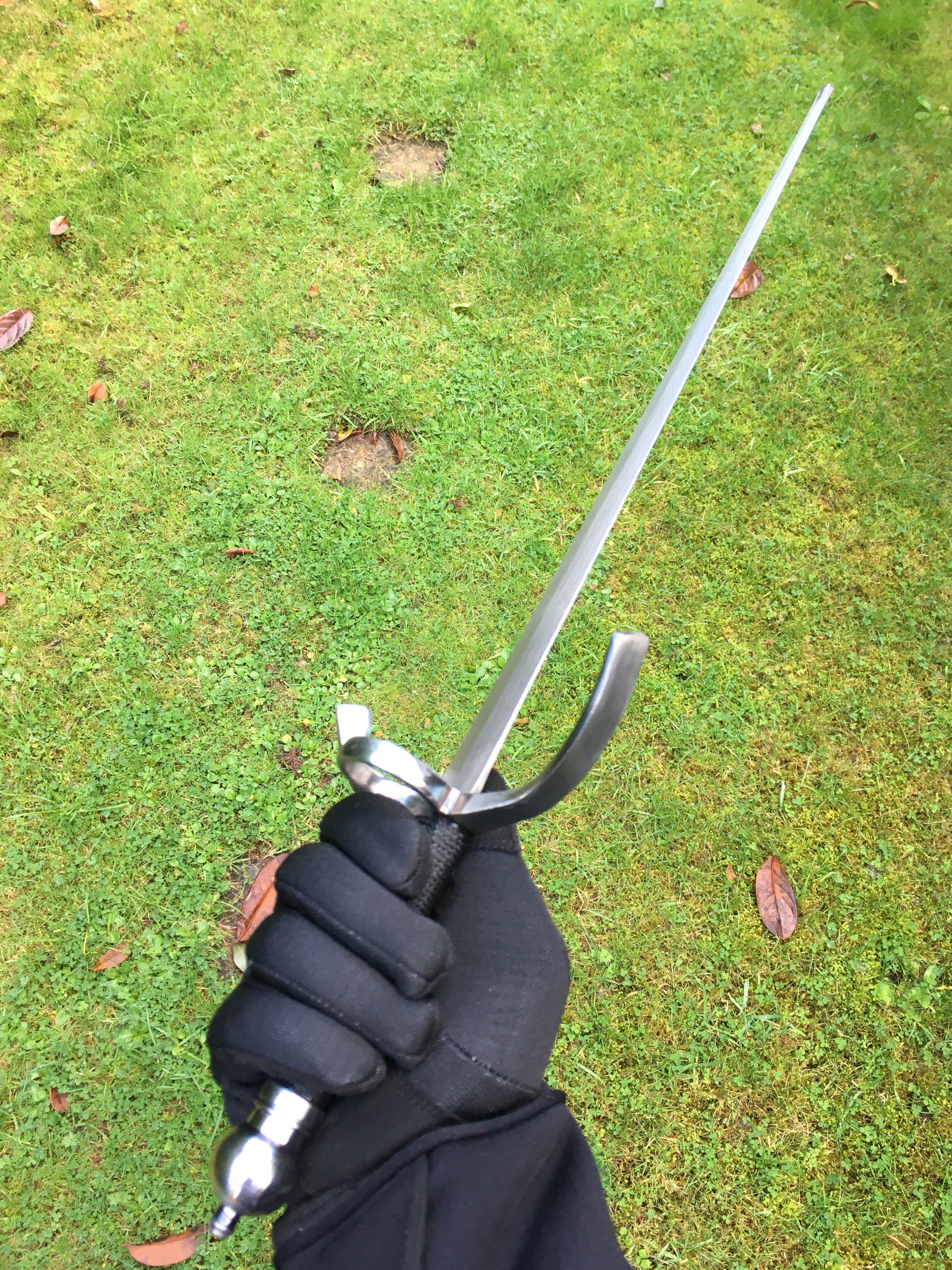
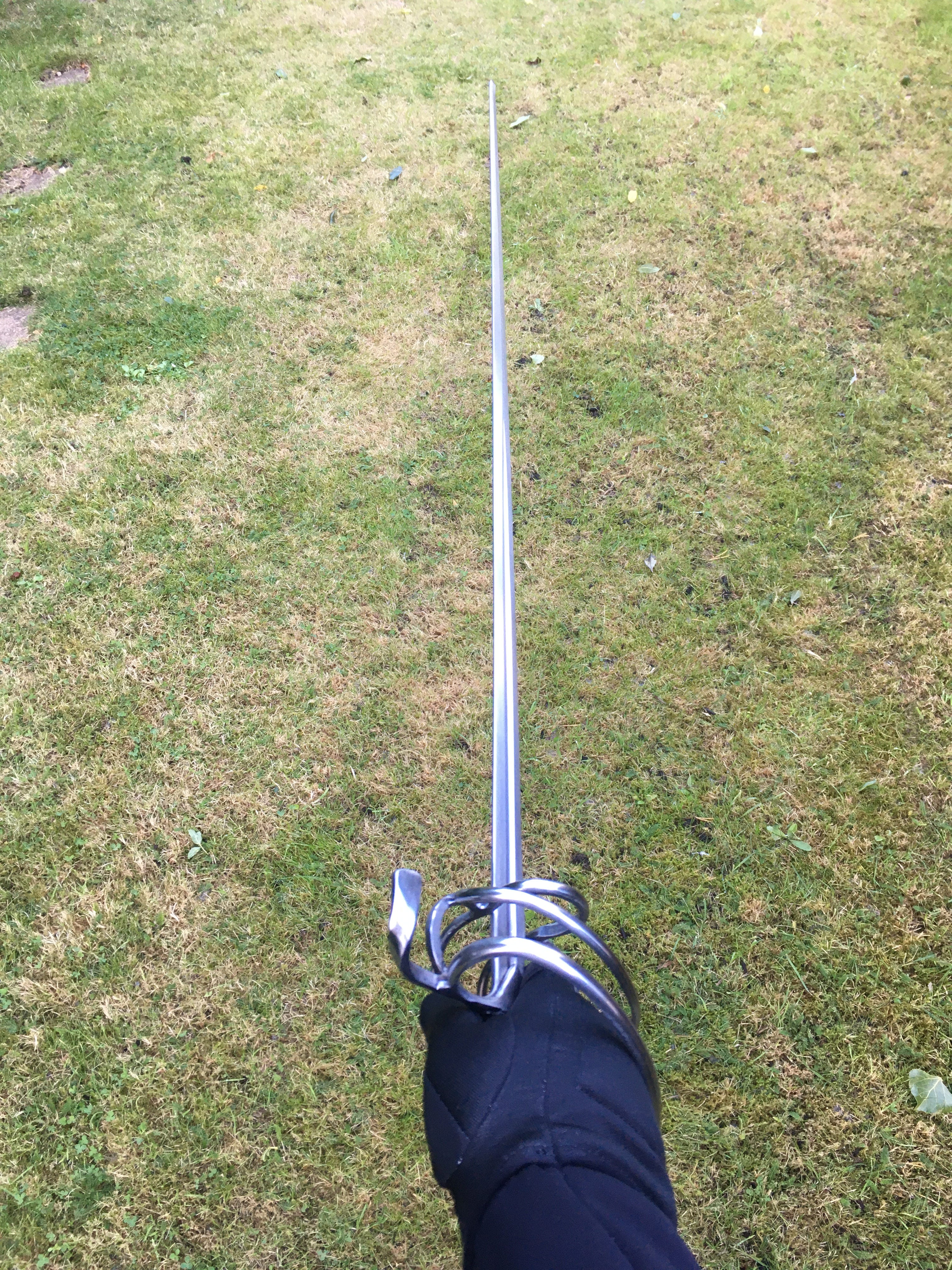
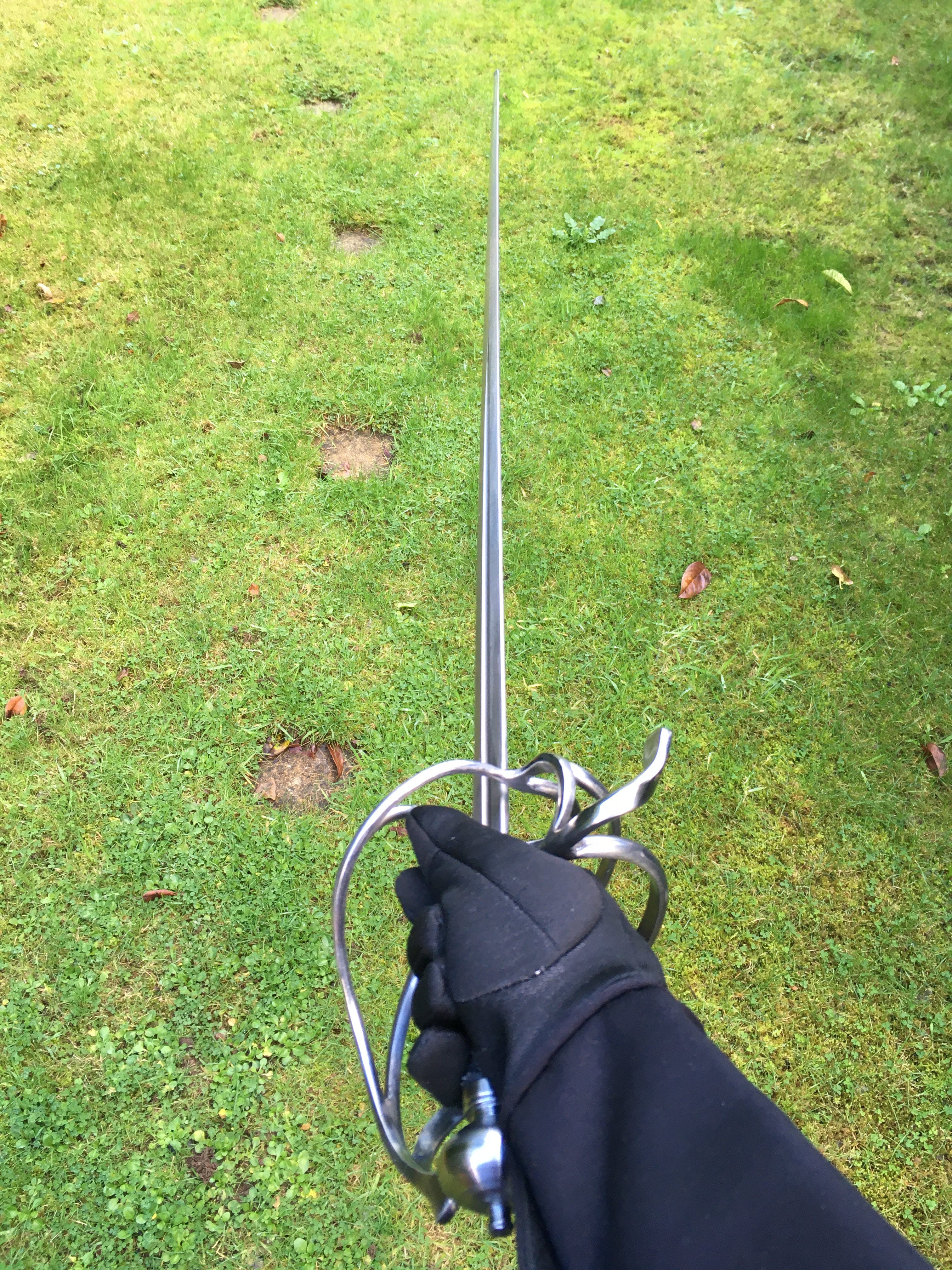
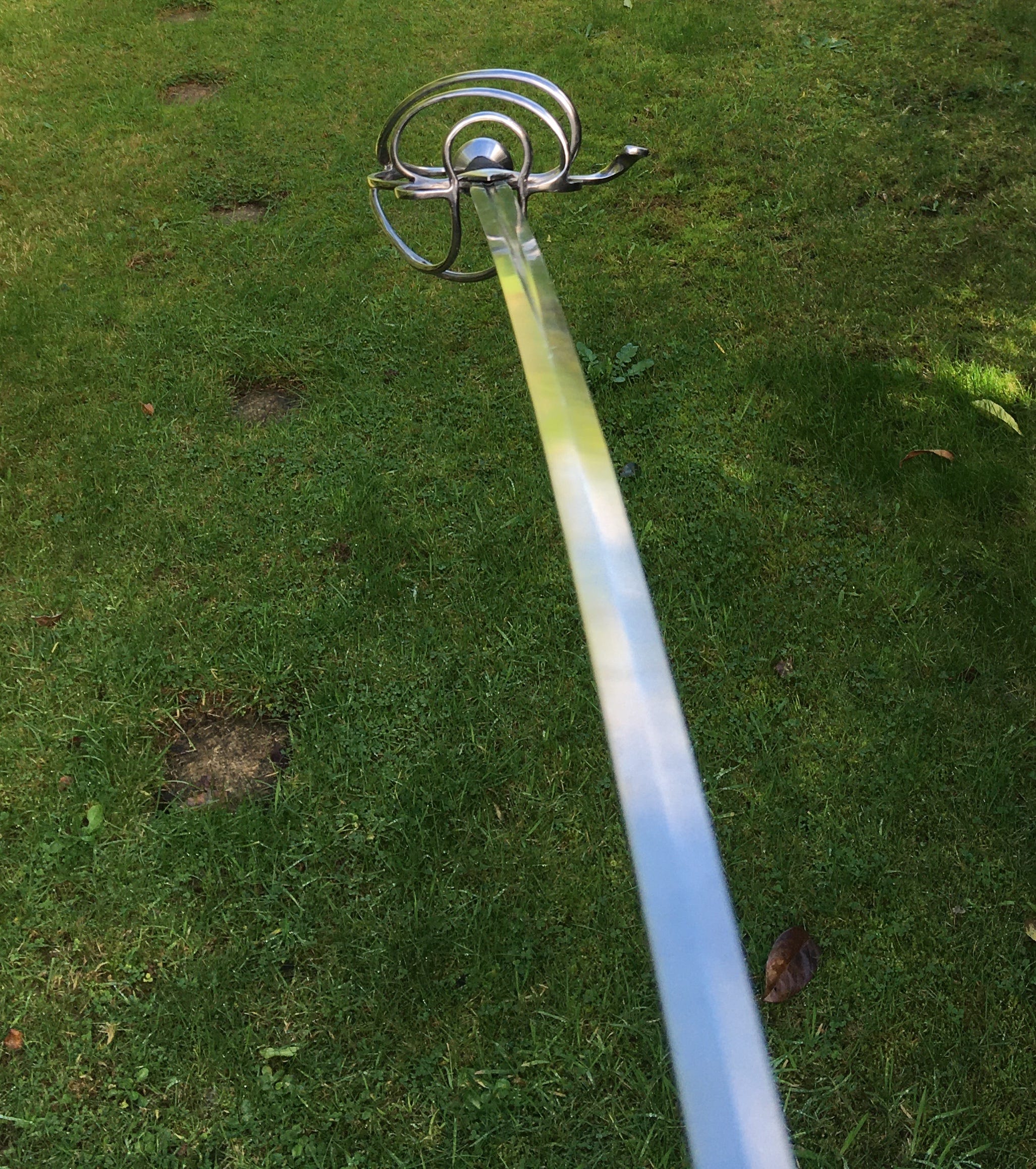
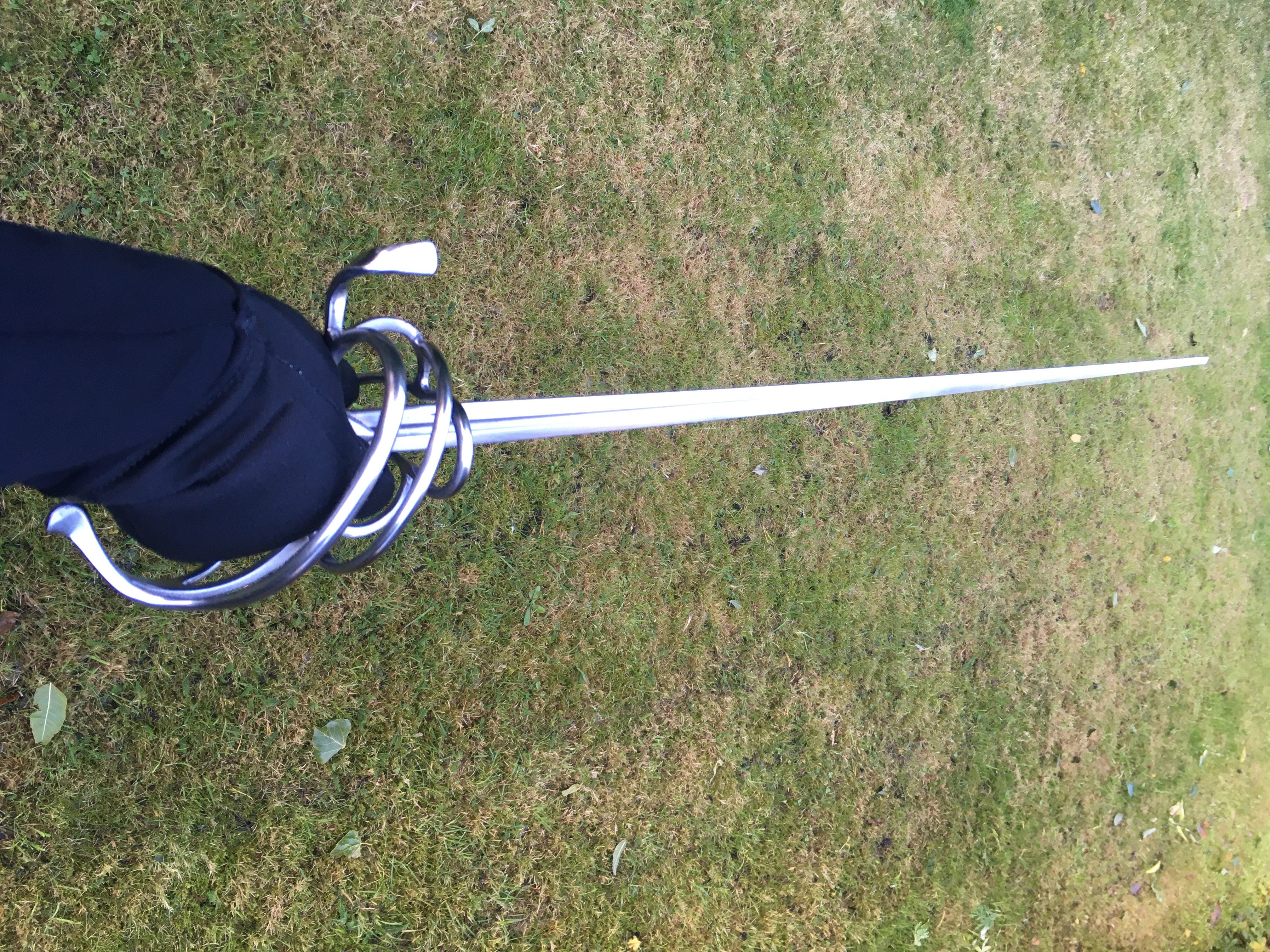
I love the look of this piece. I didn’t believe that it would end up looking so good. The D-shape bar used for the outer sweeps offers a lot of rigidity and matches my expectation level. The blade is made from 0.5cm stock and it is stiff. Due to the length of the blade, I consider the 9kg flex (measured using a bathroom scale) to be safe in the thrust. Some welds look rough, but they are within my expectation level. All photos were taken after I cleaned the rapier and dagger.
What surprised me, was the apparent weight when I picked up the rapier from the package. That was due to the point of balance, which is 16cm in front of the quillon block. That is 4cm more than I expected, and I will talk about the implications below.
Weight: 1215g
Total length: 127cm
Blade length: 114cm
Blade width: 2.4cm
Hilt length: 12.5cm
Cord grip length: 8cm
Ring to ring width: 11.5cm
Balance point: 16cm


With an 8cm long black cord section, the grip is not long. The pommel rests at the base of the hand, and most if not all rapier grips are possible. I have found out that two fingers of the crossguard grip makes the rapier feel lighter and locks my hands in a straight line with the blade. But is this what I want for this rapier?




Final Thoughts
I am having fun using this rapier, but I am also quite green when it comes to rapier systems. I am using it like a long sidesword, so I don’t use it properly at this point. I targeted a 1200g weight and a 12cm point of balance to have a light rapier, one that would allow me to be a bit lazy as I get accustomed to the arm forward position.
So using it with a lot of wrist cuts, the actual 16cm centre of balance feels too much. While the lower weight does help, it tires the hand. I experimented with adding some weight to the pommel, raising the total weight to about 1350g (from 1215g) so that I can pull back the centre of balance to 14cm. I think the rapier felt nimbler, but I couldn’t test this properly due to the way I secured the extra weight.
Some simple mathematics (and physics) told me that for 1g at the foible of a sidesword, I need to add about 2g to the pommel to keep the same centre of balance. For a rapier with a long blade, for every 1g around the tip, I need to add 4g to the pommel. In this case, I would need to remove around 40g from the foible of the rapier’s blade to move the centre of balance from 16cm to 14cm. That’s about 1cm wide, 50cm long, 1mm deep strip of steel, so it sounds doable. However, I am afraid of what it will do to the stiffness of the blade, and as such, I won’t experiment with this.
On the other hand, I adapted quickly to the 16cm centre of balance on the 1215g rapier. The blade is very strong in the bind, and since it has a 9kg flex, it offers a lot of control. So is the 16cm point of balance just too much, or is this is actually good, with me simply not knowing how to harness it due to my lack of knowledge?
The fact that my initial sparring session was against a partner that was just as green as me, further complicated the issue. The opposing weapon was a sidesword and small buckler (23cm diameter, so 9inch), with the dagger and buckler being swapped between the two sets. I can say that sidesword and small buckler is at a disadvantage against a long rapier and dagger. The bucker has no real chance to stop a rapier, while the dagger is so much better at trapping or deflecting the opponent’s blade. We all know this as being the reason why left-hand daggers started being parred with rapiers, but sometimes, experiencing on your own something known as a fact is so refreshing. In one simple sparing session, I experience the evolution of 100 years of fencing systems. Oh and, being at the receiving end of a 114cm blade thrust to the face, without being able to react and mitigate the attack, made me close my eyes (and Capoferro plate 8 came to mind). It’s so scary when you experience that for the first time, especially when you don’t know how to avoid it. Rapier fencing systems are fun!
There is another issue, that of the system used. I think that inline-rapier systems where one’s position and ability to deflect the opponent’s blade matter a lot suit this weapon, while quick disengagements that draw from Destreza are not suited to it. My conjecture is backed by historical pieces listed here, with a 17cm point of balance being observed on a long-bladed 1620g rapier from the Wallace Collection.
Please don’t take this presentation as a full review or as a criticism. I simply don’t know if it’s me, if it’s the rapier, or if it’s the way I use it. All this makes me incredibly introspective and keen on finding out more. I will look at other trainers, learn more about how to use rapiers, and decide on what feels right for me as time goes on. It may also be that I would need different tools for different tasks. Time will tell, and I look forward to finding out.
A really interesting review, thanks for taking the time to write in such detail about your swords. They sound like good pieces. And thanks for the mention!