
The Arming Sword Problem
and why this label can be misleading

Most of us agree that, while terms such as arming sword or sidesword can be ahistorical, they are useful in differentiating swords in modern conversation. Others object to the use of the term sidesword, and say that we should just call them swords (spada), since that is what was done in the period. They want fewer labels, not more, and I can understand their position in that regard, even if I don’t agree with it (and I’ll explain why at the end). However, I find it curious that the same people are loose with the use of the term arming sword. In my opinion, this is a much more problematic label.
The arming sword term was designed to refer to the sidearm sword worn by knights / men-at-arms (even if I would say that other troops, regardless of armour, used it). Yes, we have the terms espées d’armes in French and short armyn swerd in English used in the 15th century, but we equally have espada ropera in the 15th century and (if I squint) spada a lato used by Agrippa in his 1553 work. In the end, even if there are historic roots for these labels, the modern use is still ahistorical, as we are using modern re-labeling of these terms. Here, I will go over some issues I have with the arming sword label, which has the potential to misrepresent the use of the swords.
Glasgow Museums Collections Examples
I will start making my point with a few examples from the Glasgow Museums, one of, if not the most unreliable online sources of swords that I can access (I will leave my disdain for them for another time, but I don’t like their priorities one bit).
Three Swords
Let us look at the next three swords: the first one is just 70cm in length*, the second looks the same, but it is 107cm in length, and the third one is of a different type, but at 110cm it is similar in length to the second piece.
*if this is indeed the total length, the grip is just 7.3cm, while if it is the length of the blade, the grip would be 8.6cm (either way, a short example, as many other such swords exist).
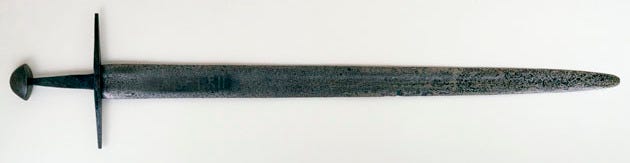
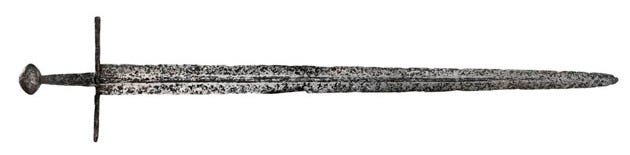

The first remark that we can make is that a hilt is a cultural product of a time and place. The style of a hilt doesn’t automatically define the use of a sword. This is not to say that the hilt has no impact on the use of a sword. But too many times we fall into the trap of assigning a sword a type based on the hilt, expecting that piece to behave in a certain way as a result, rather than looking at the blade and the overall dynamics.
The 1st sword, with a blade some 60cm or 70cm long, is on the shorter side. It is a sword you can have on you at all times, hanging by your belt, ready to be used if needed. The point of balance matters less on such a short sword, be it as a piece with a fine tip control or as a chopper. One should be able to draw it quickly and use it as a relatively nimble sidearm as a result of its reduced size.
By comparison, the 2nd sword, even if it has the same type of crossguard and Brazil nut pommel as the 1st, has a 90cm plus long blade. Most likely, it has a forward point of balance, which would make it unresponsive (slow) when used on foot (based on my experience with Tod’s Viking Norman Brazil Nut Sword). Such a sword from the early period is effectively a pallash, a sword to be used as a powerful cleaver while mounted. Using it behind a shield as a powerful cleaver might also work, but it’s out of the question to use that sword on its own. Already, we see that this cannot fulfil the role of some nimble swords that you can pull out of the scabbard at a moment’s notice.
The 3rd sword is clearly a later anti-armour sword, as in, a sword to be used against armour, most likely while employing half-swording techniques. It’s a somewhat sharpened crossbar to help you wrestle in armour. I saw Italians separate these thrust-focused swords from the rest by referring to them as having stocco (estoc) blades. I will use this designation here and there in the rest of this post.
These three will do for now, but there are plenty of other one-handed swords in museums that fall into one of these three categories. All these are one-handed swords, but they clearly have different functions. Why would we want to mix three different sword types under one label? Why would we want to call them all arming swords?
Yes, to a certain degree, all could work in any role if really needed, but the intent of use behind each design is different. Only one of them (the 1st) fulfils the proper role of a sidearm, and that’s the role I expect from an arming sword (short armyn swerd). Saying that the other two are also arming swords, obscures their different function. To drive the point home on overextending the label, I will look at the following piece.
A Strange Sword
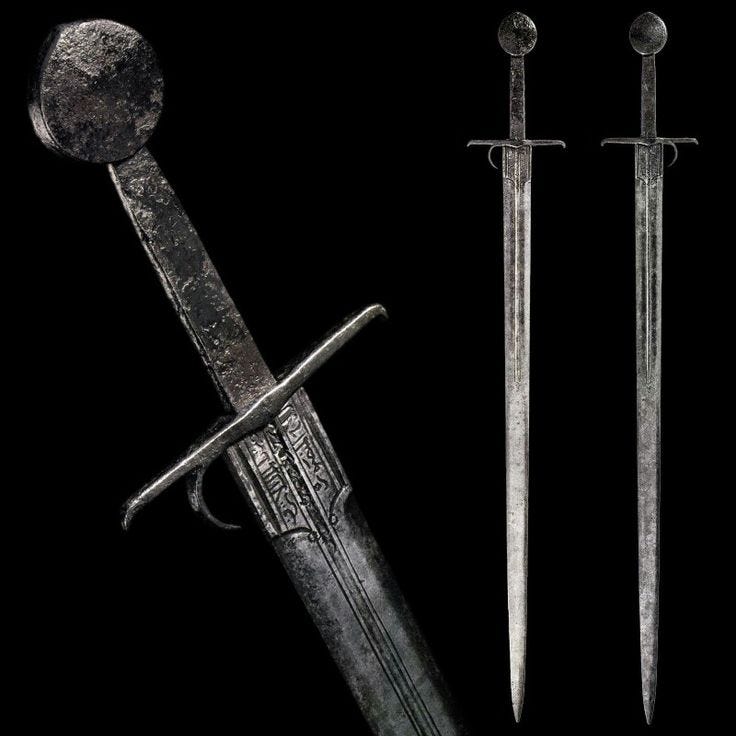
This sword is 119cm long. The blade is over 105cm long, on a one-handed piece from the 1200s. I would have dismissed this as a mistake (check the weight listed in the pic) if not for the photo showing this piece next to swords with long, two-handed grips. Yet this is also supposed to be an arming sword based on the museum label. A blade that is over 105cm long, seen as a sidearm, really? If we accept this piece, the arming sword term is so overextended that it becomes meaningless. I should also say that this sword is used as an example of a typical Crusader sword, to my dissatisfaction. And now we see another problem with assigning the wrong label to a sword, namely that, by doing so, we misrepresent our expectations of history.

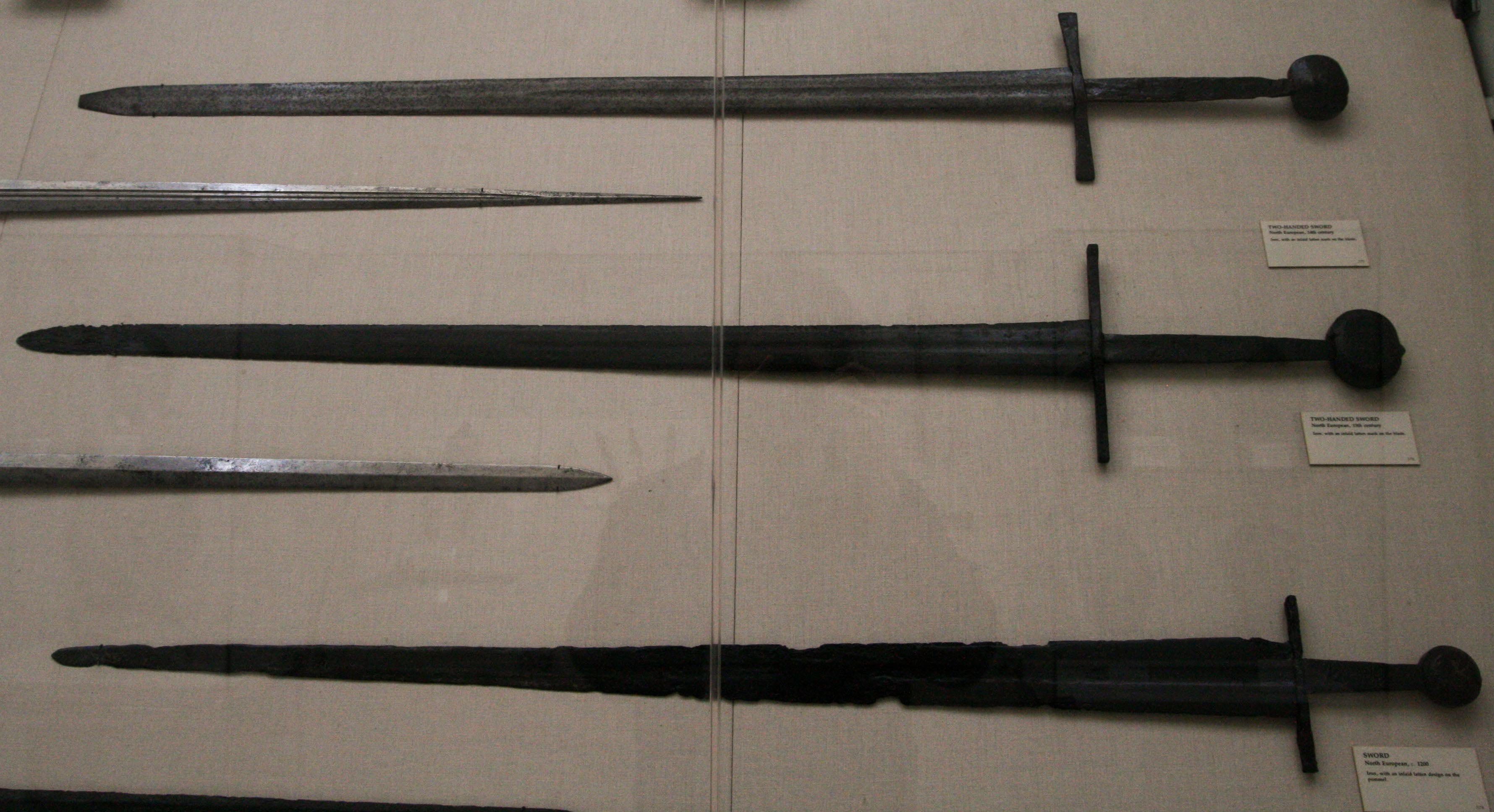
Small pause to share a few more pictures and the opinion of a friend that the tang looks repaired to him. I did mention that I don’t trust this reputable museum.


Now, let us remember that we already have the term one-handed sword to refer to a sword with a grip that can only be used with one hand. We already have the cruciform-hilt term to refer to the generic hilt type, as separate from Dark Age sword hilts (late antiquity, migration and Viking era). And if we know the era, just saying sword suffices. Saying arming sword adds nothing if all the swords from the era are arming swords. Plus, as a small sidenote, while I can tell you what a one-handed or a two-handed sword looks like, the transition is not that clear. And again, in my opinion, the distinction is given by the use, or at least by the intent of the use behind a design.
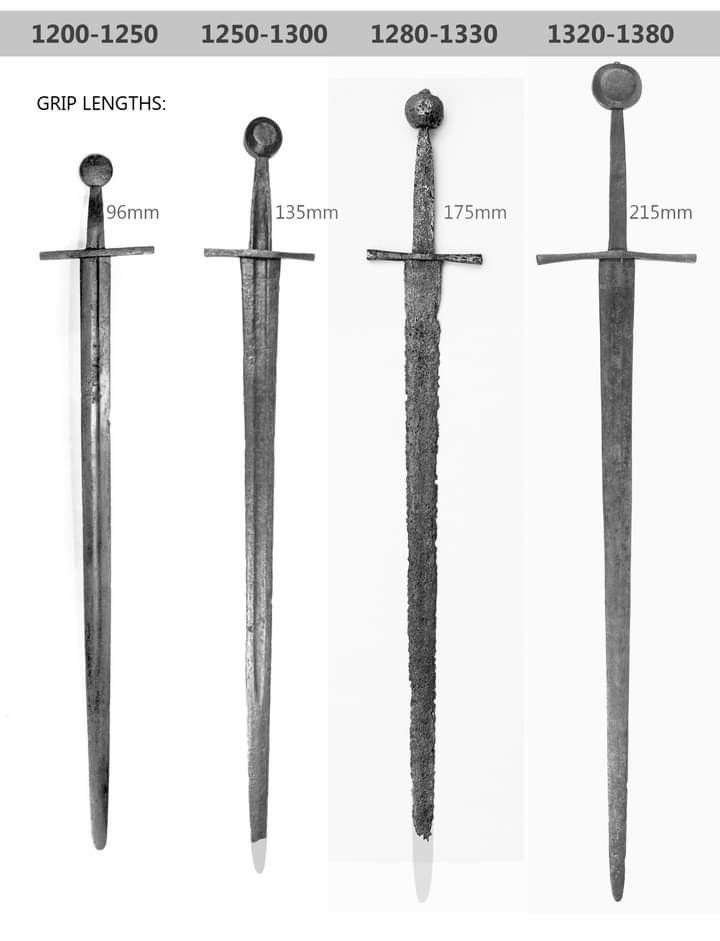
This is why, for me, an arming sword needs to be a clear sidearm, not too long, and not intended as a main weapon. It cannot be a pallash type, or a dedicated anti-armour sword for half-sword use (even if arming swords with estoc blades do exist), or a longsword that just happens to be carried by the side. Basically, if you carry it on your horse as a secondary weapon, it’s not an arming sword. If your squire hands it to you as it’s too cumbersome for you to carry, it’s not an arming sword. If you can use it well with longsword techniques, it’s not an arming sword. Anything else results in a meaningless designation. And again, what is the point in calling swords that fulfill different roles an arming sword? I just don’t see it.
Castillon Horde Swords Examples
I want to look at examples from the two groups, A and B, used to classify the Castillon Horde swords to further refine my idea that the blade type doesn’t equating use intent.
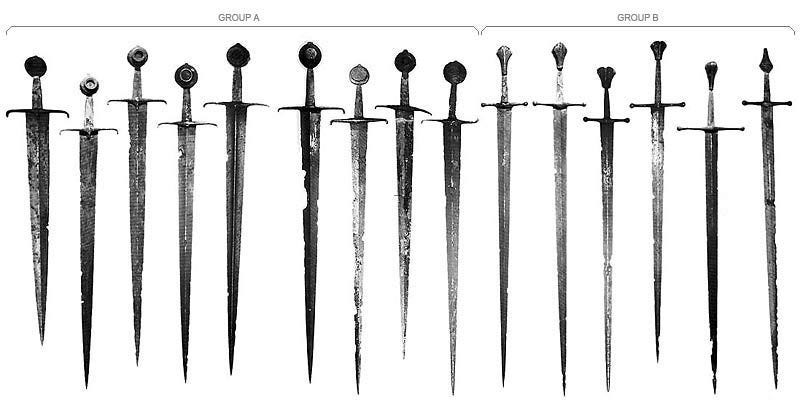
Yes, with small exceptions, the Castillon Horde swords (especially the ones in the above group picture) are swords with thrust-centric blades that have diamond cross-section profiles (seen as Type XV or Type XVIII on the Oakeshott sword typology). These are really nice swords from c.1453, specialised for the thrust.
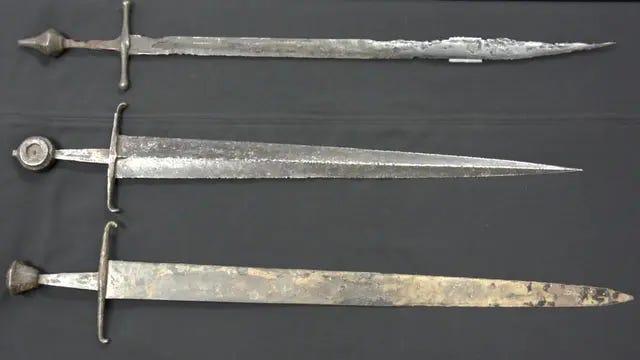
Yet this specialisation for the thrust is employed in at least two different ways. One way for Group A, ~70cm long blades with a big pommel that facilitates drawing the sword and locking the hand in the grip. And a different way for the ~90cm long blades in Group B, where the longer grips and effectively narrower blades seem to indicate a preference for grip flexibility and half-sword use. For example:
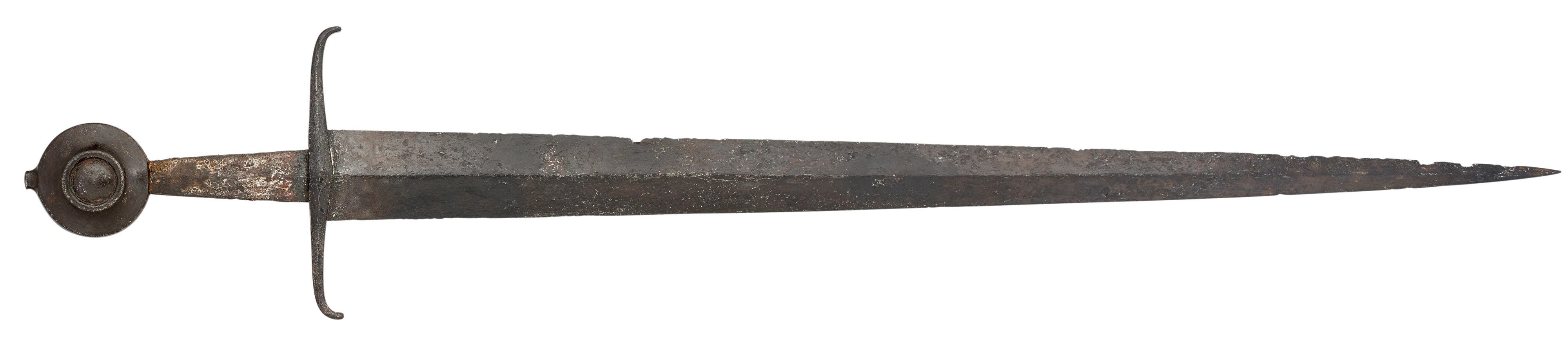

Matt Easton has two videos presenting these two exact pieces (A & B), and the stats listed are given by him. Incidentally, I simply love the clean look of this B sword.

At this point, some people would be right to point out that the listed Group B sword is probably intended for mounted use by men-at-arms. The extra length of the blade and the forward PoB would support this use, and so would the size of the grip. When dismounted, this piece also becomes a good choice for half-swroding, but the size is more of a necessity for mounted use. So if this, let’s say, is the sidearm for mounted troops, why wouldn’t the term arming sword be appropriate? And again, for me, the term arming sword doesn’t capture anything from the considerations provided for mounted use, and mixing between use types does a disservice to the clarity of the communication on the intent of a sword. But this is not because of the blade’s type.
As I see it, Group A has more in common with cut-oriented, broader-blade pieces (such as shown below as an example) than any of the Group B swords. Thrust or cut is just an adaptation considering the target, but the idea is the same: a not-so-long sword that you have on you and can extract with ease at any moment.
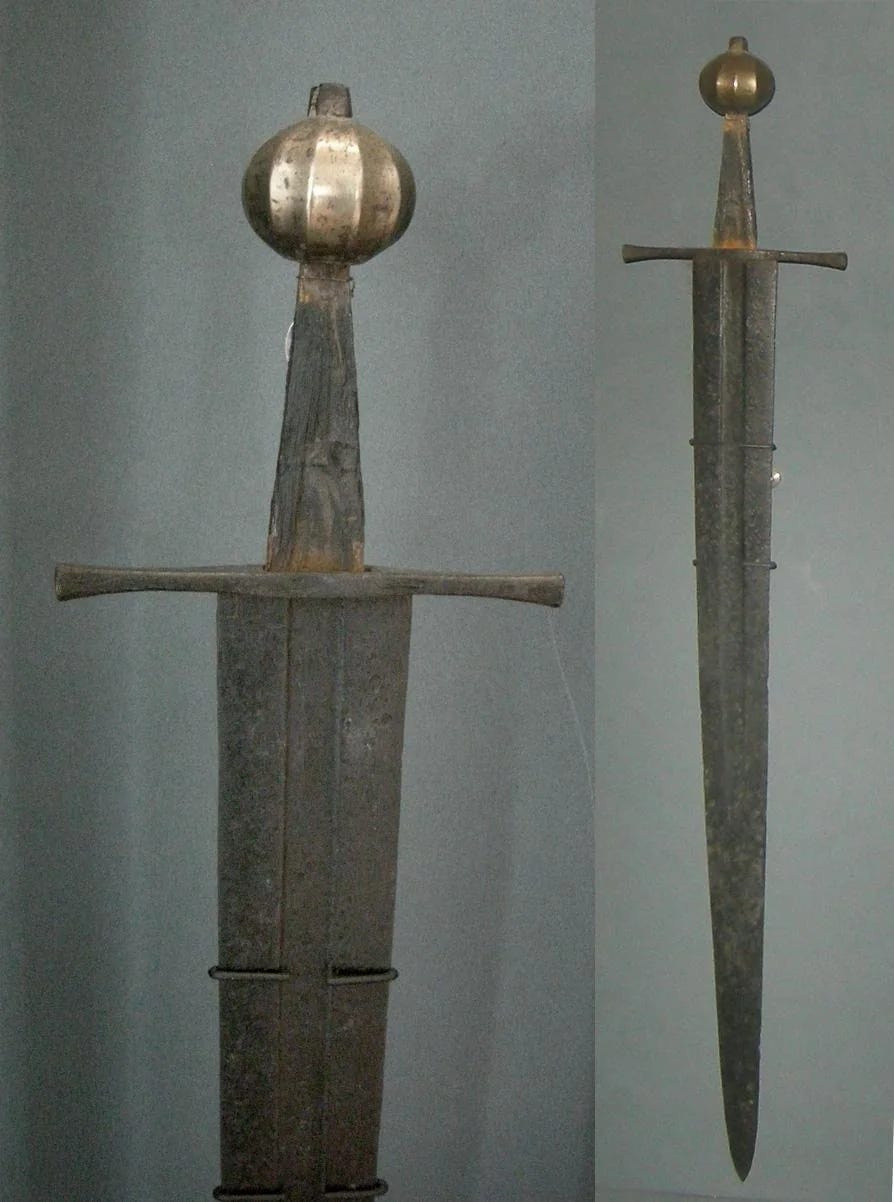
A Different Group B Example
Let’s complicate matters further. The following piece from Group B is held in The Royal Armouries. We are provided with some measurements, but no point of balance or measurements regarding the thickness of the blade and its distal taper profile.
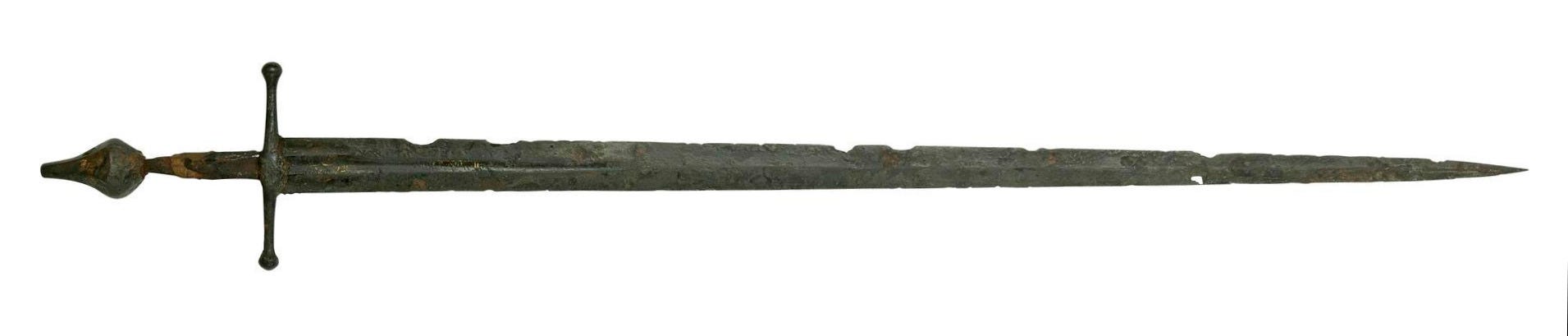
TL: 109.3cm, BL: 92cm, BW: 4.1cm, Pommel Length: 7.3cm, Weight: 1012g
This is a substantially lighter sword compare the other Group B we looked at (i.e. blade may not be that thick and rigid). The grip is just large enough to fit one hand. Even with a PoB of some 15cm, it would still feel good in the hand. In fact, it may help stabilize the point as you maneuver the sword around while keeping the tip on target. Plus, the blade is only 4.1cm wide at the base, where it has a nice ricasso. All these hint at this sword being designed with the intent of fingering the crossguard (so even more fine tip control). All the measurements scream at me that this would fit better the role of a sidesword rather than an arming sword. And I don’t say this in the sense of how it looks, but in the sense of seeing this more as a main weapon for some troops, rather than a sidearm. Yes, the role I’m assigning is speculative, but it showcases yet another way to use a sword that would be muddled when placed under the same label. I want to look a bit at the idea of sideswords being arming swords.
Not All Sideswords Are the Same
A legitimate question emerges, which I want to address here as well. Are all sideswords the same? And I don’t mean in the sense of more elaborate hilts from different periods. If we have different blades, on them, are they still sideswords? Let’s have a quick look at the following two examples that have similar hilt types.
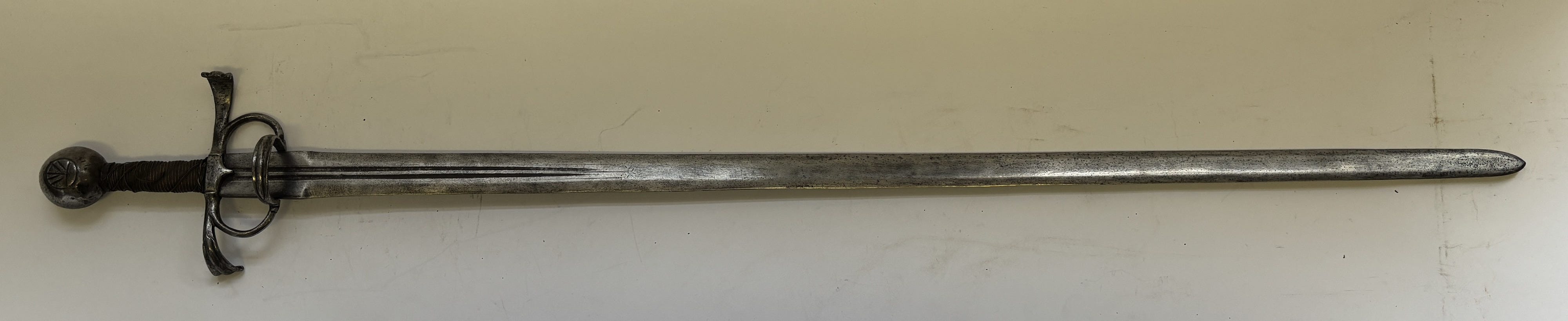

TL: 107cm, TW: 15cm, BL: 94.6cm, BW: 3.55cm, BT: 0.6cm, PoB: 20cm, Weight: 1196g.
When I saw these stats, PoB and weight in particular, I started to speculate that it was optimised for mounted combat. And in fact, it may still be. But the same dynamics also suggest an optimisation for sword and buckler, or sword and rotella. You depend on the off-hand to defend and deliver an authoritative cut. The smaller span of the quillons (15cm) might be due to this use, as you don’t depend on them to protect the hand that much. Least probable, in my mind, is this being just a personal preference to use as a sword on its own. Note that the person who handled it stated: “Not nimble. Heavy on the wrist. Wielding it you do feel a lot of cutting power. Still sharp.“
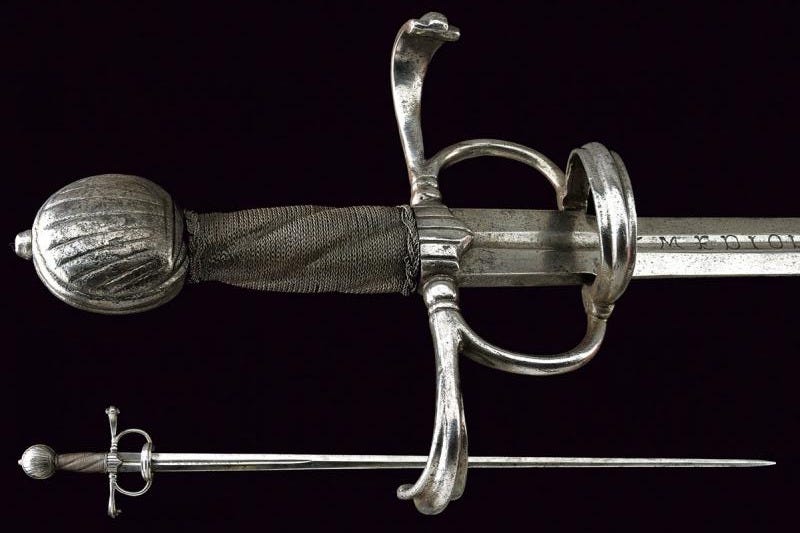
This other piece from c.1546 has a total length of 123.5 cm. From the photo, I estimated a 107cm long blade. The width of the blade is estimated to be 3.25cm. It’s clear that these two have different blades; one is optimised for the cut at the tip, the other focuses on the thrust. One is presumingly for use with a buckler and cut with the broader tip, while the other is for single sword use (or with a dagger). Yet both are just optimisations for different aspects of the same weapon system, the sidesword.
And I don’t see them as arming swords. They are the main weapons you rely on from the start, defining the type of troops that use them. I can see sword and buckler troops being deployed with these sideswords as their main weapons.
Why Sideswords Are Not Arming Swords
In this video, Matt Easton talks about the LK Chen Ribaldo. After delivering some beautiful cuts that make use of the full length of the blade to accelerate and cut with the tip (i.e. perfect example of cutting with a sidesword), he states at some point (4:50 in the video) that he sees this as an arming sword. So why do I disagree on this?
LK Chen Ribaldo: TL: 109.8cm, BL: 93.4cm, BW: 3.95cm, BT: 0.525cm, Guard Span: 13.65cm, Grip Length: 10.5cm, Pommel Length: 5.3cm, PoB: 20cm, Weight: 970g.
He is right that this is a medieval sword. But this sword has more in common with swords from 100 years later than the ones from 100 years earlier. While the PoB is quite forward, the weight is low in a way that earlier swords are not and could not achieve (not for this blade length; we see on average some 300g difference). Just check the cuts done at the start. Those are not the type of cuts you would do with a sword from the 1200s with a 90cm blade, for example. Why would I want to muddy the waters even more by including this type of sword under the arming sword umbrella?
Since this is more of a main sword that you would use with a buckler, separating this type from the rest also helps to see clearly some historical realities. Namely, that sideswords are much older than we think, and what makes a sidesword is not the hilt, but use. More on this in the next post, as this deserves its own consideration.
Closing Thoughts
For me, the intent behind the use matters a lot. While I am a proponent of a sword being able to fall under multiple labels (i.e. non-unique categories), if the label becomes too wide, it becomes effectively meaningless. In a way, my uncertainty whether a sideswrod was intended to be used mounted or with a buckler shows that there is enough actual overlap, maybe even a causal link where lighter versions of pallashes started to be used as sideswrods, without the need to add to the uncertainty by adding effective hangers into the mix.

If a label does a good job of capturing the use of a sword, while another just creates confusion in that regard, we should think twice about using the latter. We are doing ourselves a disservice by merging too many different swords under one umbrella. In the past, we placed too much under the arming sword label: sidearms, pallashes, anti-armor estoc-type swords, sideswords. In fact, most sword types up to the 1500s not placed in this category are the longswords and other two-handed swords. For one-handed swords, only single-edged swords are excluded from this label, and in some cases, they shouldn’t be, as they fulfill the same role.
This also impacts HEMA, where we seek (or should seek) trainers that are authentic in terms of use. If we group too many distinct types under one label, we risk reaching the wrong conclusions. We may conclude that the reconstruction of a technique is true or false simply due to the sword used (in terms of reach, mobility, or power). A Norman sword used with a kite shield is not going to do well for I.33 sword and buckler, where a shorter and lighter sword will perform better. They are meant for different things. So why should we then group them under the same label?
A similar situation can exist for the sharp reproduction market, where we may decide that an arming sword is badly balanced simply because we picked up a pallash optimised for something else, instead of a more reasonable, shorter sword. And how would we know better, if they already have the same historical hilt, and everything is just labelled as an arming sword anyway? Not overextending the label is a matter of managing expectations when it comes to particular swords, rather than filtering them out as undesirable. Doing so would just leave us with less variety.
Last, why did I say in the first paragraph that I don’t agree with people who want fewer labels? Why do I prefer more, just to be pedantic? No! As someone who enjoys movies and video games that make use of historic swords, I found out that the label used for a sword dictates its depiction. Producers of such media won’t always spend a lot of time on details. They want a simple association, at most. Having a label that, in addition to period and culture, also implies a certain use would facilitate the correct depiction of swords in media. This, in turn, adds more authentic notes to pop culture. Instead of twirling around, a character (in a movie or game) would use a sidesword as a sidesword, a pallash as a pallsch, and an arming sword as an arming sword.