
Why Mass Distribution Matters
...it was my understanding that there would be no math

People may not care about the maths, but I want to show something relating to swords, and I am using numbers, formulas (which we can skip) and a simple setup to showcase how mass distribution can change the feel of a sword in a nonintuitive way.
At 7:30, in this guide video on buying a feder, Federico Malagutti gives a nice, simple example to help people visualise how mass distribution matters. Imagine a bar you rotate by hand at the middle (helicopter rotor style). You place some weights on each side close to the point of rotation. You now shift the same weights further out to the end of the bar and rotate. Doing so becomes progressively harder. Why? Because the moment of inertia that affects rotation depends on mass and on the square of its distance to the point of rotation. You need to put in more effort to rotate the same mass the further it’s out, and you need to also need to put more effort into stopping it as well. It’s the inertia to changing the rotation motion.
In simple terms, while the units and the values for the moment of inertia tell me nothing, a lower value means that I can initiate a rotation or stop one with less effort. Swords rotate a lot during use (shoulder, wrist, their point of balance), so lower values for the moment of inertia mean a nimbler sword.
My Setup
I spend some time thinking of a similar case, something simple that can help me gain some intuition on the impact of the mass distribution on a sword. But I want something more, so I crafted a different setup. I use a three-mass setup, so three weights on a 100cm long bar (the bar has no mass of its own). Two of these weights are at the ends, and one is at the 15cm mark. See the sketch below.
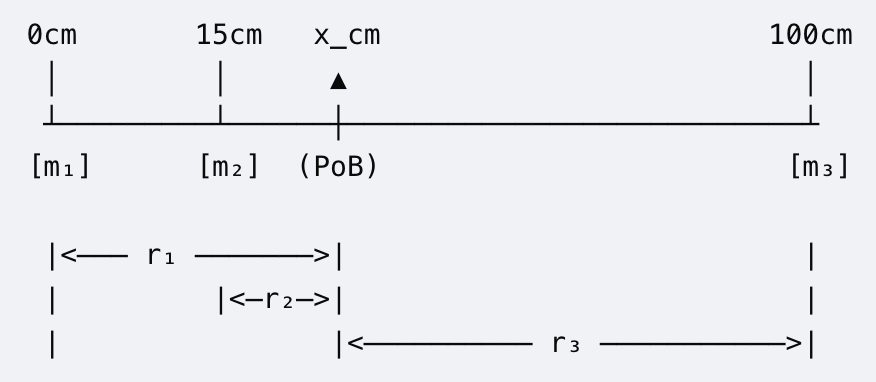
I want to rotate around the Point of Balance (PoB) and compute the Moment of Inertia (I). Imagine m1 to be the pommel of a sword, m2 the mass of the ricasso of the blade or the forward part of the hilt, and m3 to stand in for the rest of the mass of the blade. Rotating around the PoB also makes sense for wrist cuts, to a certain degree. I’ll talk a bit at the end about this.
I should point out that there is no way to reduce the moment of inertia of an object by adding mass on top of an existing configuration (it’s a physics theorem), but there is a way to do so by redistributing the existing mass. That’s why I want a three-mass setup. Also, adding more mass exactly at the point of rotation does nothing to change the moment of inertia.
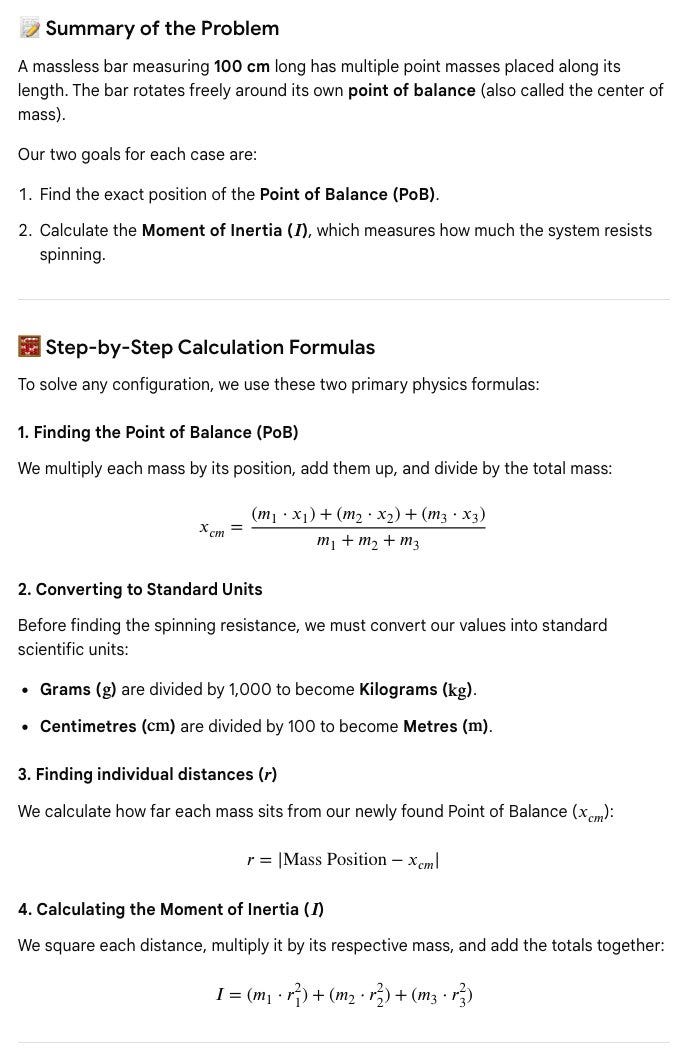
This is the math... I got Google to summarise for me. You can see the relevant formulas there and the results in tables afterward.
Distributing the Mass
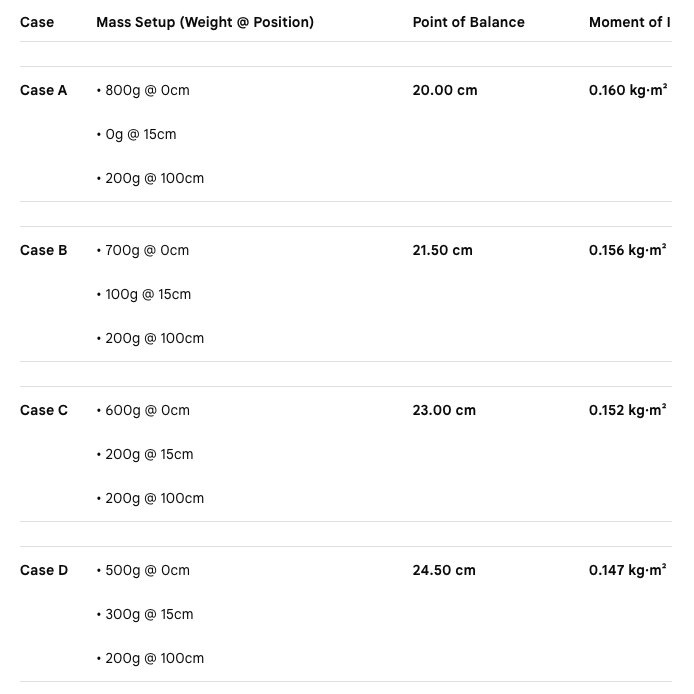
I consider a 1000g mass in total. While I won’t touch the mass at the tip of the blade (i.e. m3 will stay 200g), I shift more and more mass from the pommel (@ 0cm) to the ricasso (@ 15cm).
What do I see? While the PoB is getting larger, the moment of inertia gets smaller. Meaning that it rotates with more ease around the PoB, so such rotation feels nimbler (with the caveat that this is true if you continue to rotate around the PoB, as I do).
Distributing & Adding Mass
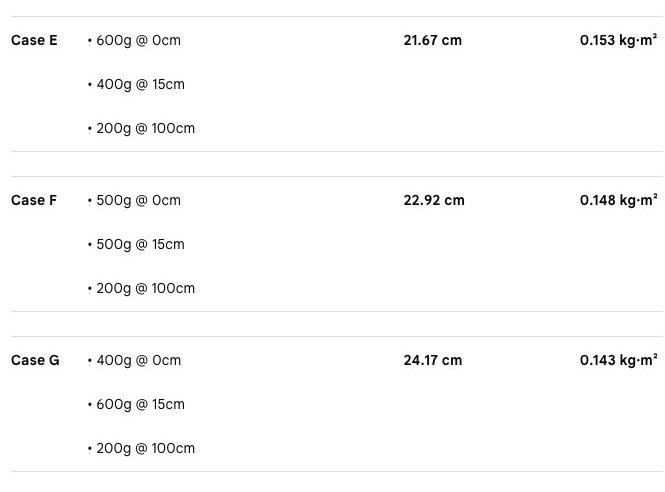
How about if I increase the overall mass (by 200g here) and add it to the ricasso area? While heavier, we still can get a marginally smaller PoB and lower moment of inertia than previous configurations. Just compare case F and C above. The point here is that a heavier sword may not automatically feel worse than a lighter one.
Fixed PoB Scenario
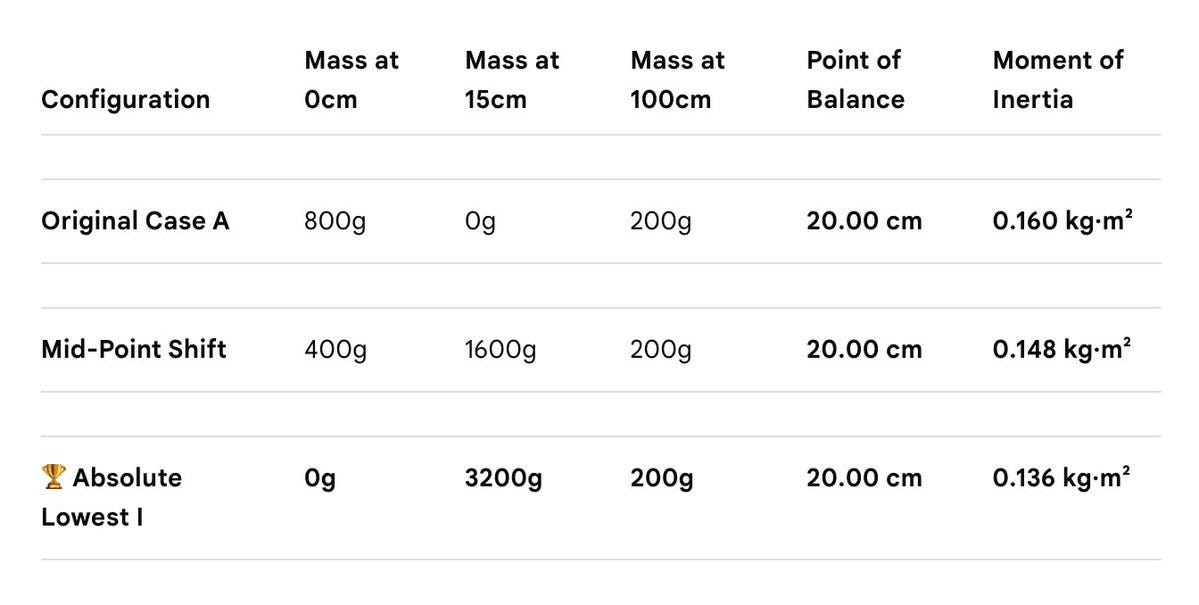
How about we fix the PoB (here at 20cm) and the mass of the rest of the blade (here 200g), and we vary the mass of the pommel and ricasso stand-ins, such as to get the smallest moment of inertia. What do we see? The best result is when the ricasso has all the mass. Concentrating more mass closer to the point of rotation (here PoB) results in a smaller inertia to rotation. We see that in this case, the mass increases a lot, but the rotation around the PoB would be easier to perform.
In general, this shows that less mass in the pommel and more mass better distributed around the hilt may be a better solution in obtaining a nimbler moving blade. Maybe more complex hilts, closed ports and that extra protective shell may not be the worst choice to make, even if the overall mass increases. One thing is for sure, that really thick ricasso on old rapiers starts to make a lot of sense now.
Few Conclusions
while PoB matters, it is not the most important measurement. It helps me understand why I have played with trainers that had the same mass and PoB of antiques, but not their feel in the hand.
a lower moment of inertia is what allows a sword to have a faster rotation motion, and since most motions are in an arc, this translates to nimbler sword control.
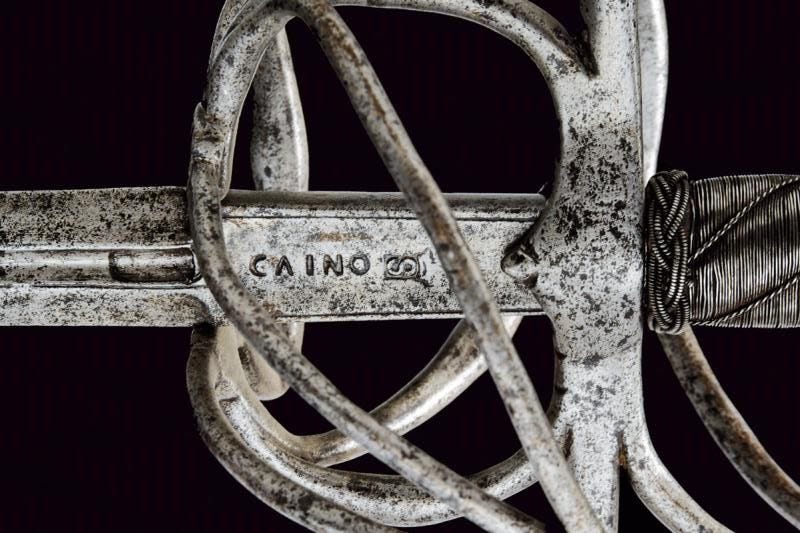
a thick ricasso on rapiers (1cm on some Caino blades) helps in this regard, and it’s preferred to putting all the mass in the pommel.
sometimes, mass is not your enemy, and adding mass can improve the feel. This feels wrong to say, but it’s true.
Final Thoughts
Well, there are a few caveats to this simple exercise that I should address. First, yes, this is a simple overall scenario. Mass is not distributed in three parts; it’s a continuum, and in practice, you need to do integrals. Nobody is doing that, and intuition formed from experience will help a swordsmith more. But now you know why articles (www.rapier.at) show cross-sectional surface areas with length. It allows one to gauge the mass distribution. Let’s look at one example from the report on rapiers from the Armoury of the Grandmaster’s Palace in Valletta, Malta.
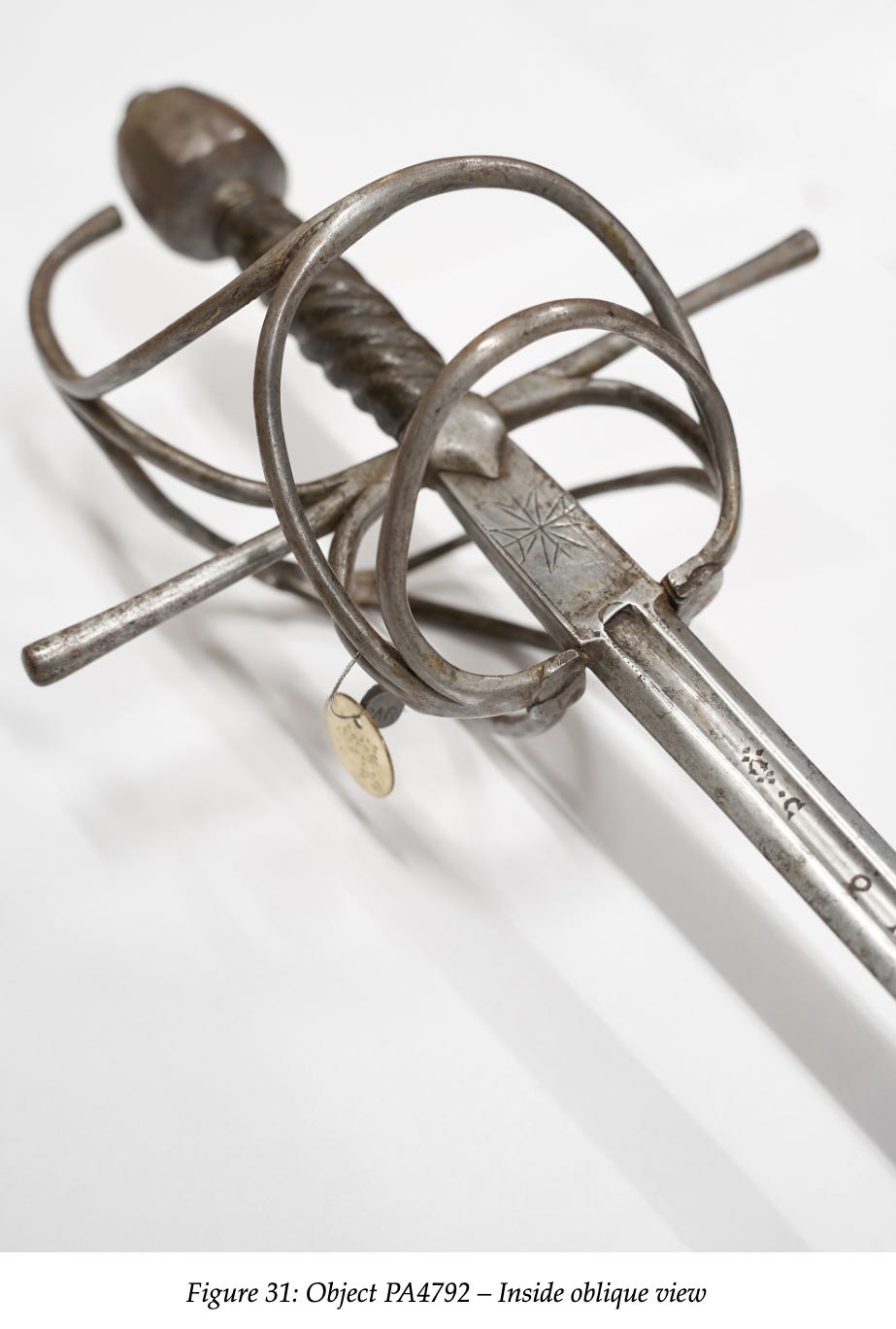
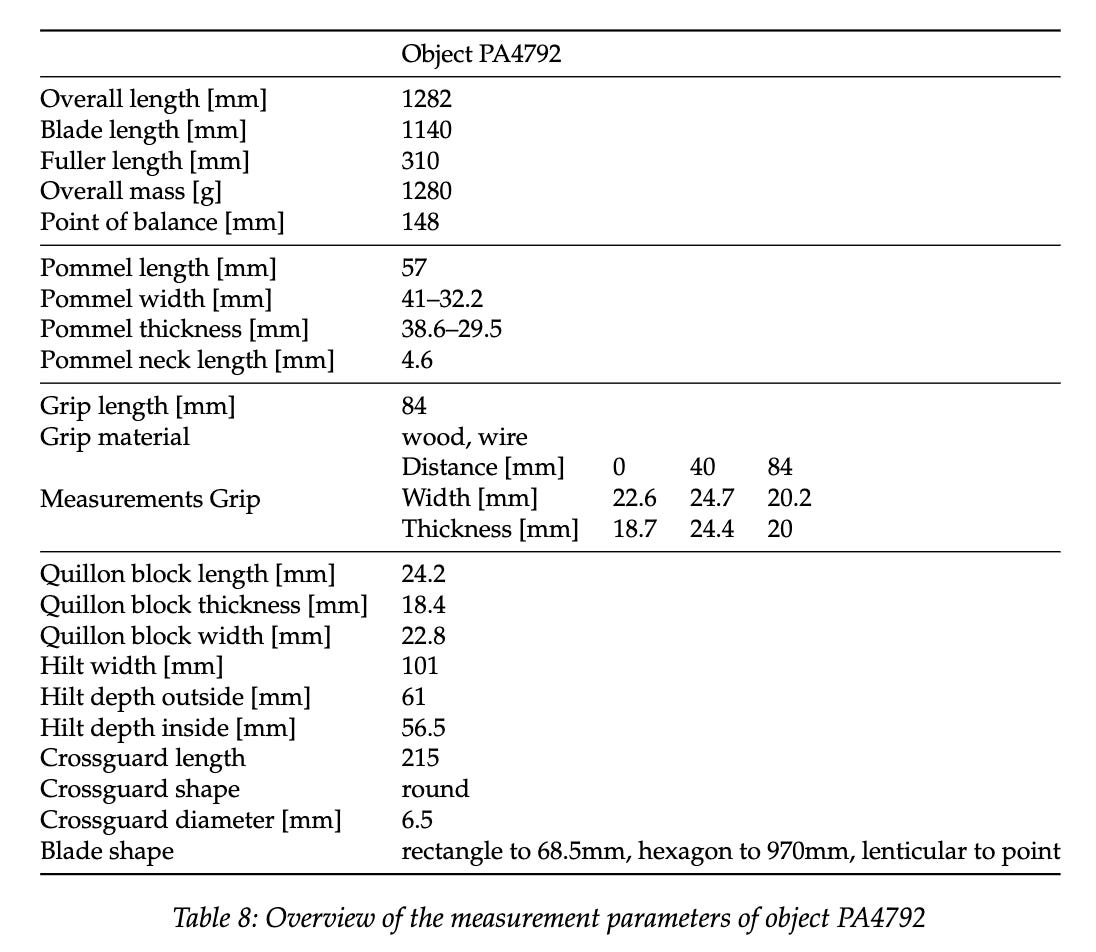
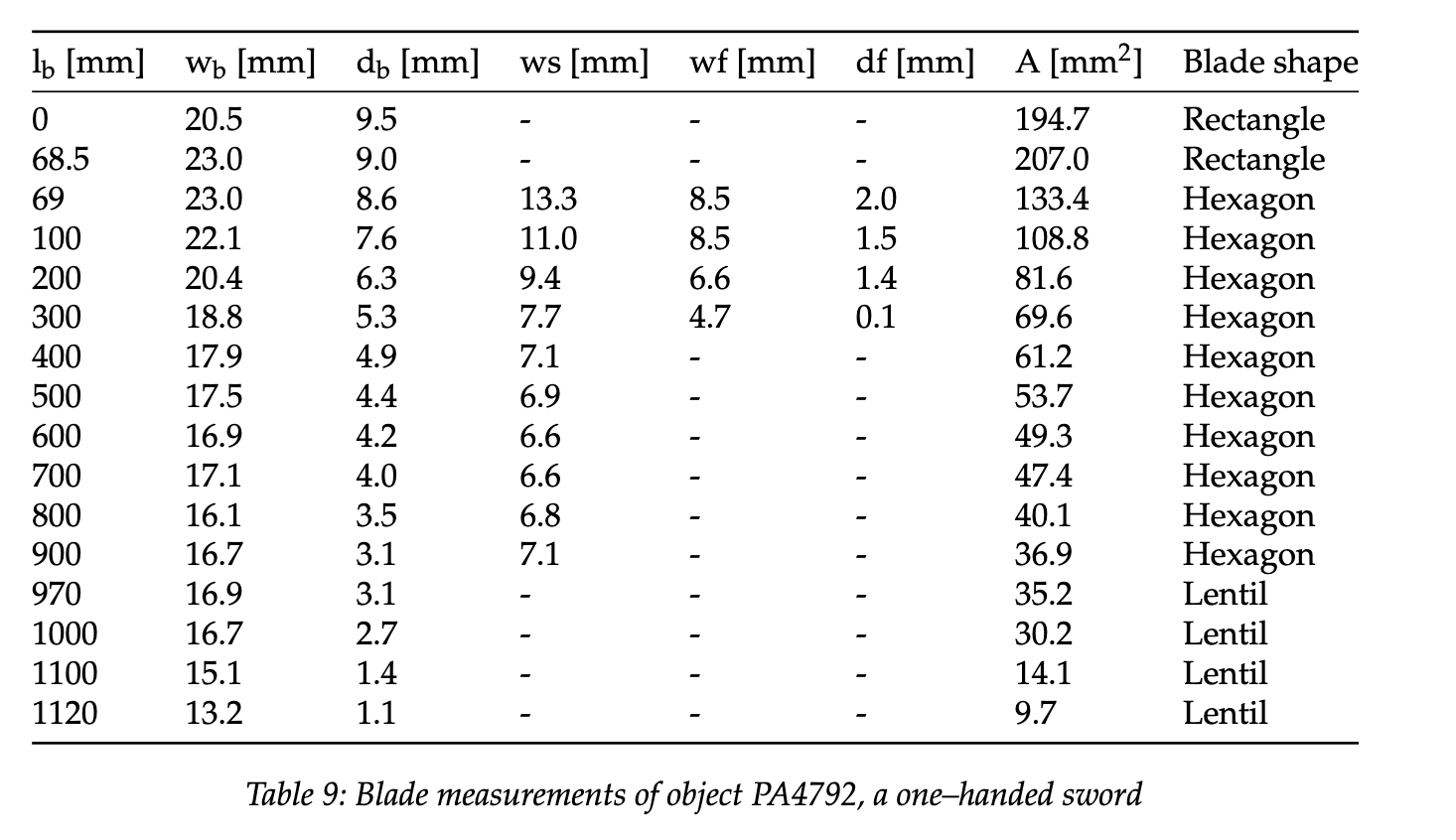
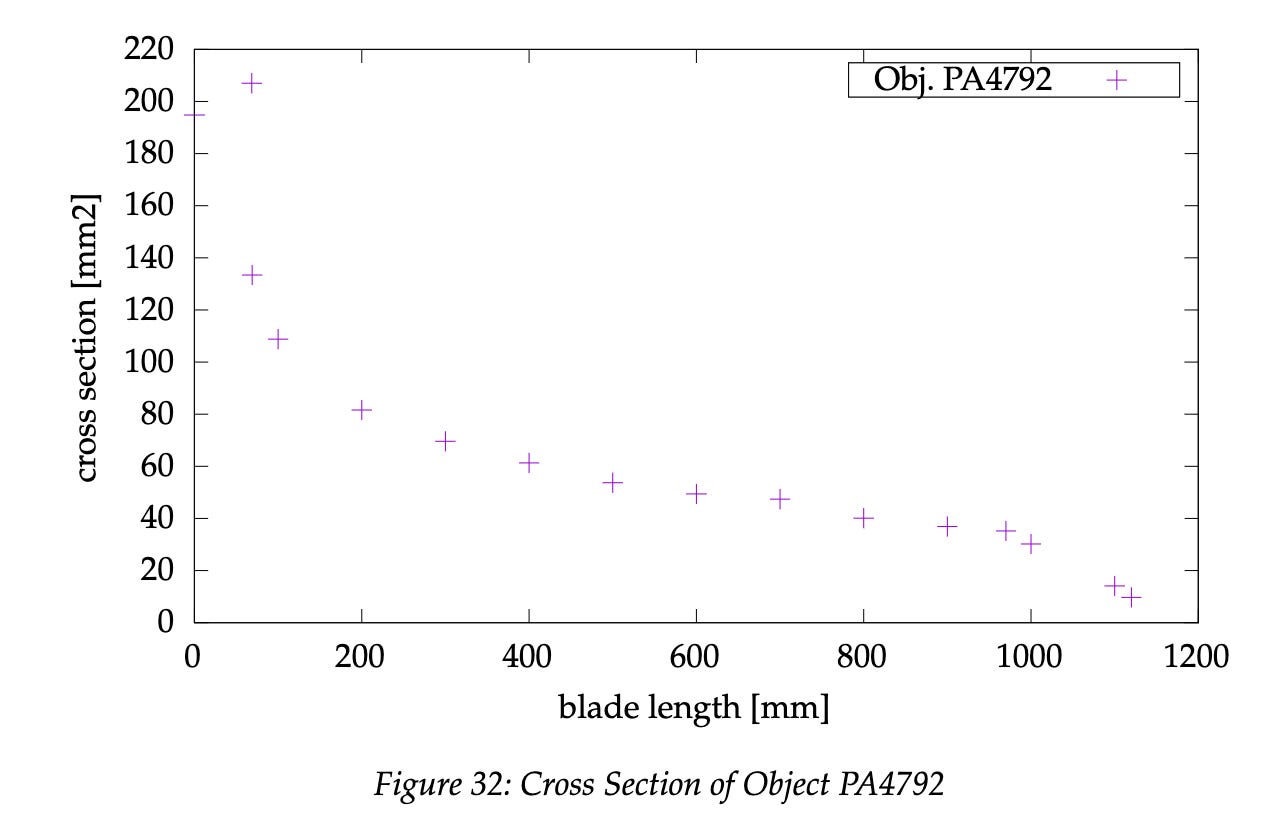
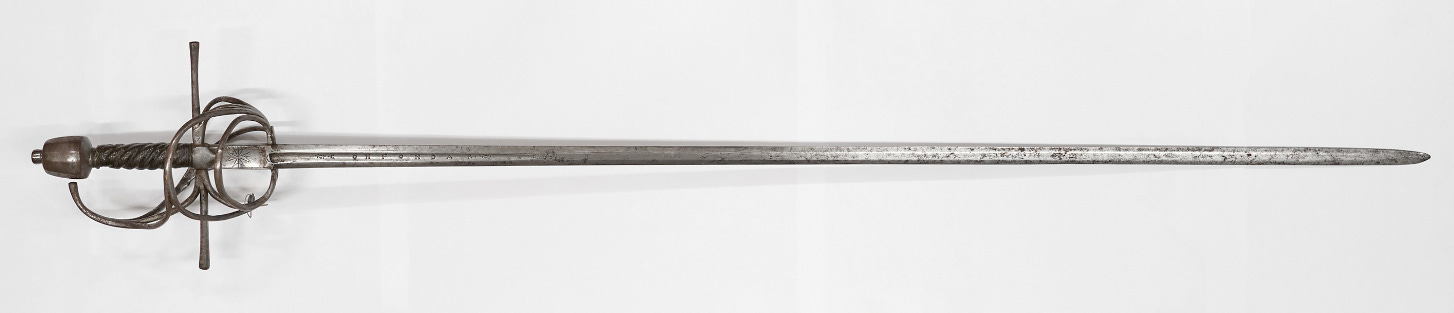
We see that the example presented here has a lot of mass in the ricasso, about the same as the last 3rd of the blade at the tip (calculations ‘done’ by eye). But recalling our simple setup, this choice reduces the need for a heavier pommel while reducing the effort to rotate the blade around the PoB.
A more advanced consideration
The mass distribution (cross-sectional area) for the rest of the blade after the ricasso, and ignoring the tip, goes down as the inverse of the length squared. Skipping the maths, it indicates a tendency to have a constant moment of inertia density, so the total moment of inertia would be some constant times the length of the blade we look at. Meaning that each mm of the blade adds the same rotational resistance/inertia.
If the blade had constant mass along its length (so a simple bar), the total moment of inertia would scale with the length of the blade cubed. But fitting curves and putting this fit data into a computer and getting the numbers just equates to the point: it’s a bad idea to leave a lot of mass at the tip!


I added via Google some general calculations for flavour, and to recall this exercise for myself if I want to. If you remember your integrals and want to look at them, feel free. The point is that in the absence of a distal taper, things go bad as the cube of the length of the blade, so really fast! This is also why longer blades become trickier to balance correctly. And while we know the maths in theory, I doubt swordsmiths want to think of blades in these terms. This is why experience making sword blades matters.
A second caveat that’s quite important is that rotation doesn’t happen just around the PoB. Depending on the moves you perform and the type you do more of, to be precise, you may find one balance configuration to work better for you than another. This is where experience with using different swords comes into play. And this is also probably why we have so much variation when it comes to antiques.
I will end with an anecdotal fact. While I have found that I am performing my tramazzone more around the PoB these days, I am not sure why. They feel easier to do, and I have more power coming out of one, but I don’t know if I haven’t perverted my form, or if this is how it should be done, and I have just naturally drifted into what’s expected from a wrist cut. For clarity, as I initiate a wrist cut, I push my hand forward, effectively rotating the blade around the centre of balance. I have also found that forward balanced swords feel nice now, put less strain on my wrist, and I can hit with so much more authority. Are we sure we should interpret the same lessons in the same way for cut vs thrust sideswords? I am not there yet to tackle this question.
Another question I have not seen mentioned anywhere is the use of gauntlets. I have a huge Swedish houdegen (around 1400 grams, circa 1630), with a very large basket hilt. I believe it is made to be used with steel gauntlets, then it handles beautifully. The steel gauntlet would make the same effect at the pivotal point, balancing the blade without adding more inertia to that of a large globular pommel... when handled from the wrist. If moved from the elbow or shoulder, instead of 1400 gramms, you impact with above 2 Kg.
I believe the problem is actually more complex and I think a reason for the popularity of taza hilts in the second half of XVIIth century. With an Italian hold (one finger across the cross) or Spanish hold (two fingers across the cross), the cross is the real pivoting place of a sword, even if the balance is some inches forward. Masses forward and backward could balance each other, but they will give you inertia.
The question is, what happens with the mass at the pivotal place, the cross. That mass counts toward the balance of the blade, but it does not produce inertia as a pommel does. In a taza hilt you have there the thickest part of the ricasso, the quillions and the reinforced taza border.
Many taza hilts have stumped short grips, huge quillions and no proper pommel, and this is not by chance.